
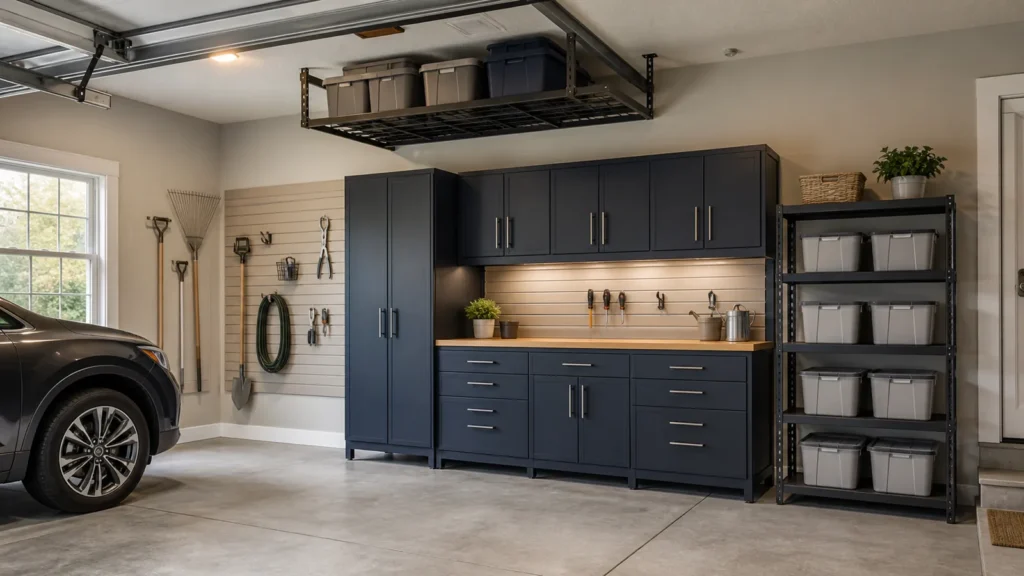
A useful garage storage plan rarely comes from choosing one “best” system. Freestanding shelving, cabinets, wall tracks, slatwall and overhead racks solve different problems. The right answer depends on what you store, how often you reach for it, what parts of the garage are truly available and what the exact product can safely support.
This comparison is part of Larmine’s Home Improvement planning library. Browse all homeowner guides and calculators for other room and project decisions.
Quick Decision Matrix
Begin with the job each system performs best. A hybrid plan often works better than forcing every item into matching cabinets or covering every wall with panels.
| System | Strongest use | Access | Protection | Space used | Main planning check |
|---|---|---|---|---|---|
| Freestanding shelving | Bins, bulky supplies and frequently used equipment | Fast and visible | Low unless containers provide it | Floor and wall edge | Unit footprint, stability, shelf dimensions and product-rated load |
| Modular cabinets | Tools, visual clutter and items needing controlled access | Moderate | Better dust and visual control; lockability varies | Floor or wall, depending on model | Door/drawer clearance, assembly, anchoring and floor conditions |
| Slatwall panels | Broad, reconfigurable wall coverage for varied gear | Fast | Open storage | Wall | Compatible accessories, wall construction and installation instructions |
| Track/rail systems | Targeted hanging zones for tools, bikes or sports gear | Fast | Open storage | Selected wall bands | Rail length, accessory ecosystem and approved mounting method |
| Overhead racks | Bulky, infrequently accessed seasonal containers | Slow; usually requires a safe retrieval method | Depends on container | Ceiling volume | Door travel, vehicle clearance, structure and exact manufacturer requirements |
| Hybrid system | Garages with several storage jobs | Matched by zone | Matched by item | Floor, wall and possibly overhead | Preventing systems from competing for doors, cars, work areas and circulation |
Garage Storage Planner
Use this tool to identify a primary and supporting system to investigate. It evaluates use patterns—not structure or load capacity. Select the answer that describes the majority of your storage, then review exceptions separately.
Measurement notes
Longest usable wall: ______ Ceiling height: ______ Vehicle width with doors open: ______ Largest bin: ______
How to use the result
Treat the recommendation as a shortlist. Measure the proposed zone, inventory the exact items and compare current products. A hybrid result does not mean buying everything at once; it can mean installing one useful zone now and preserving a compatible path for expansion.
Start With an Inventory, Not a Product Catalog
Retail categories encourage you to shop by cabinet count, shelf width or panel coverage. A better first step is to sort the storage job by item behavior.
- Frequently used: yard tools, sports gear, charging tools and cleaning supplies need visible, convenient positions that do not obstruct a vehicle or walkway.
- Heavy: equipment, dense hardware and bulk liquids require product-specific support and often benefit from lower placement. Weight must be checked against the exact shelf or cabinet rating and the complete installed system.
- Bulky but light: seasonal decorations and empty coolers may suit elevated zones when retrieval and structure are appropriate.
- Small and valuable: hand tools and accessories benefit from drawers, bins or enclosed cabinets that make missing items obvious.
- Hazardous or restricted: pesticides and certain household chemicals require label-directed storage, controlled access and separation from food, feed and medical supplies.
- Dirty or wet: garden, snow and sports equipment needs a zone that tolerates moisture and can be cleaned without contaminating stored household items.
Five Garage Storage System Types Compared
1. Freestanding shelving
Freestanding racks are the simplest way to add visible capacity without covering a wall with a proprietary system. They work well for labeled bins, frequently used supplies and oversized items that fit the shelf depth. They can also move when the garage plan changes.
The trade-offs are floor consumption, exposed contents and the need to manage stability. Compare the exact unit’s overall dimensions, shelf dimensions, leveling provisions, assembly method, material and product-rated distributed load. Do not combine shelf ratings or assume the garage floor is level. Follow any anchoring or anti-tip instructions supplied with the product.
2. Modular cabinets
Cabinets create visual order and can reduce dust exposure. Lockable models can support controlled access, although a lock does not override product-label storage requirements. Tall cabinets suit long items and bulk supplies; base cabinets can support a worktop; wall cabinets preserve floor area when the product and installation permit mounting.
Cabinet systems demand more planning around doors, drawers, appliances, vehicles and imperfect floors. Compare assembled versus ready-to-assemble construction, steel gauge only in context, adjustable feet, shelf ratings, drawer ratings, replacement parts, warranty, delivery and expansion options. A matching suite can be attractive, but compatibility inside one ecosystem can make future changes more dependent on that manufacturer.
3. Slatwall panels
Slatwall covers a larger wall area with horizontal channels for hooks, baskets, shelves and some compatible cabinets. It is useful when the storage mix changes and when tools, sports equipment and yard gear need to remain visible. Full or partial coverage can also create a more finished appearance.
“Slatwall” is a product category, not a guarantee that accessories from different systems interchange. Panel material, channel geometry, fasteners, wall construction, accessory ratings and installation patterns vary. Use only compatibility and capacity information published for the exact system and accessory combination.
4. Track or rail systems
Tracks provide concentrated organization without covering the entire wall. A rail near the yard door can hold garden tools; another can support sports accessories or selected shelves. Accessories are easy to rearrange within the system’s rules, and the lower initial scope can make staged installation practical.
A narrow track can become crowded when too many item types compete for the same strip. Check the current product instructions for permitted surfaces, mounting hardware, accessory spacing and rating. A hook rating is not a wall-system rating, and neither confirms the capacity of the structure behind the finish.
5. Overhead racks
Overhead storage can move bulky, infrequently accessed containers away from valuable floor and wall zones. It is most useful for seasonal items that are light enough for safe handling and stored in suitable containers.
It also carries the highest planning burden in this comparison. Garage-door travel, opener hardware, lights, vehicles, ladders, fire-sprinkler components and other obstructions can eliminate an apparently open area. The rack’s product rating does not certify a ceiling structure. Verify the exact model, installation instructions, recalled-product status and building conditions; use a qualified professional when the structure or safe installation is uncertain.
6. Hybrid storage systems
Most garages contain incompatible storage jobs. A practical hybrid might use shelving for uniform bins, a short track for frequently used tools, a lockable cabinet for selected products and no overhead storage at all. Another might use cabinets around a workbench, slatwall for changing hobbies and a carefully evaluated overhead zone for seasonal containers.
Plan the Whole Garage in Three Dimensions
Floor space
Measure the garage with vehicles parked where they will actually sit. Open every vehicle door, the home-entry door and any cabinet or appliance door. Preserve walking paths, access to utilities and the ability to move large household equipment. Record floor slope and obstructions, but let the product instructions determine acceptable leveling and installation.
Wall space
Measure uninterrupted wall lengths and note windows, outlets, switches, panels, plumbing, hose connections and door trim. Wall finish alone does not reveal the supporting structure. Do not design from a photograph or assume stud spacing, masonry condition or backing.
Overhead volume
Observe the garage door in both open and closed positions. Record its tracks, springs, opener rail and motor location. Note lights and other ceiling-mounted systems without moving or enclosing them. A professional may need to determine whether the proposed structure and location are appropriate.
Measure the objects too
A nominal 48-inch shelf tells you little if the storage bins are deeper than the usable shelf, or if the lid cannot open beneath the shelf above. Measure the largest bin, tool case, stroller, bicycle and seasonal item. Include handles, wheels and the space needed to retrieve—not merely contain—the item.
Dust, Moisture, Corrosion, Security and Chemicals
Garages can experience greater temperature swings, moisture, dust and road-salt exposure than conditioned rooms. Powder-coated steel, resin, wood-based panels and hardware respond differently. Review the manufacturer’s environmental limitations and warranty rather than assuming “garage” means suitable for every climate or wet zone.
Cabinet doors reduce visible dust but do not make a cabinet airtight, fire-rated or approved for every chemical. EPA guidance says to follow pesticide labels, keep pesticides out of reach of children and pets, preferably locked, retain original labeled containers, separate them from food/feed/medical supplies and keep flammable liquids away from ignition sources. The product label remains controlling.
Security has several meanings: keeping children away, discouraging casual access, protecting valuable tools and making sharp equipment less reachable. Compare the actual lock design and cabinet construction, while recognizing that a consumer cabinet is not automatically a security safe or hazardous-material cabinet.
Realistic Budget, Delivery and Installation Tiers
Prices and availability change, so use these as planning categories rather than promises.
| Planning tier | Typical scope | Often overlooked |
|---|---|---|
| Targeted starter zone | One shelving unit or a short track with selected hooks and bins | Containers, accessory compatibility, wall verification and future expansion |
| Mixed functional wall | Shelving plus a cabinet or track/slatwall section | Delivery, assembly time, door clearance and matching future components |
| Modular cabinet suite | Tall, base and wall cabinets with a work surface | Freight, moving heavy cartons, leveling, assembly, anchoring and damaged-part resolution |
| Designed whole-garage system | Cabinetry, wall organization, work zone and selected specialty storage | Design/service scope, installation responsibility, electrical coordination and long-term system dependence |
Current U.S. retail listings demonstrate the spread: individual organizers may cost tens of dollars, while multi-piece cabinet systems can run into several thousand dollars. Compare the complete project—not a single cabinet price—including bins, hooks, worktops, trim, freight, assembly and professional installation when needed.
Current Systems as Documentary Examples
Larmine did not physically test these products. They are included to show how current manufacturers publish different system types and model-specific documentation. They are not rankings or endorsements.
Gladiator GearWall and GearTrack
Gladiator currently distinguishes broader GearWall panel coverage from more targeted GearTrack channels, with compatible hooks, baskets, shelves and selected cabinets. Its product pages publish model-specific dimensions, ratings, installation instructions and warranties. Those numbers apply only to the stated component and installed configuration.
NewAge garage cabinetry
NewAge maintains support hubs for its Bold and Performance Plus cabinet series, including current installation and garage-planning guides. This illustrates why cabinet series, assembly method and product manual should be identified before comparing dimensions or capacity.
Rubbermaid FastTrack
Rubbermaid’s current FastTrack rail products use movable hooks and accessories for a targeted wall zone. The manufacturer publishes component-specific details and manuals. A hook, rail kit and freestanding tool tower have different roles and ratings even though they share a product-family name.
Overhead racks
Manufacturers publish exact installation instructions for specific overhead-rack models, while CPSC recall notices demonstrate why the model number and hardware matter. Never transfer a capacity, fastener pattern or installation step from one rack to another.
Garage Storage Buying Checklist
- Inventory by behavior. Separate frequent, seasonal, bulky, heavy, valuable, hazardous, wet and dirty items.
- Remove what does not belong. Dispose, donate or relocate items appropriately before buying capacity for them.
- Map vehicle and door movement. Measure with cars and every door in realistic positions.
- Map obstructions. Note utilities, panels, windows, tracks, openers and other equipment.
- Measure the largest containers and equipment. Include retrieval space.
- Choose a primary storage job. Visibility, protection, flexible wall use, floor preservation or seasonal storage.
- Shortlist a system or hybrid. Avoid buying a complete matching suite before testing the job each component will perform.
- Check exact documentation. Confirm dimensions, ratings, compatibility, installation, environment and warranty.
- Check recalls. Search the exact manufacturer and model at CPSC.gov.
- Resolve structure and installation. Follow manufacturer instructions and obtain qualified evaluation when wall or ceiling conditions are uncertain.
- Price the full project. Include accessories, bins, worktops, delivery, assembly and installation.
- Preserve an expansion path. Confirm the ecosystem still offers the accessories you are likely to need.
Frequently Asked Questions
Are garage cabinets better than shelving?
Cabinets are better when hidden appearance, selected dust control or controlled access matters. Shelving is better for visible bins, bulky supplies and frequent access. Many garages benefit from shelving for household bins and a smaller cabinet zone for tools or restricted items.
Is slatwall better than a track system?
Slatwall can provide broad, visually continuous coverage with many repositionable accessories. Tracks are useful when storage is concentrated in selected bands. Compare current accessory compatibility, installation requirements, ratings and the amount of wall you genuinely need to cover.
Should heavy items go on overhead racks?
Do not use a generic rule. Consider safe lifting and retrieval first, then check the exact product rating, installation instructions, ceiling conditions and professional advice when needed. Keeping dense items lower can reduce handling risk, but the final storage decision must fit the specific item and system.
Can I install garage storage into drywall?
The visible finish does not establish a safe mounting method. Some manufacturers publish approved installations through drywall into specified supporting construction, while others require different conditions. Follow the exact product instructions and do not select fasteners from generic advice.
How much does a garage storage system cost?
A targeted rail or basic shelving zone can begin with a relatively small purchase, while multi-piece steel cabinet suites and designed whole-garage systems can cost several thousand dollars. Compare total scope, delivery, assembly, accessories and installation rather than relying on one unit’s price.
Where should pesticides be stored in a garage?
Follow the product label. EPA advises keeping pesticides in their original labeled containers, out of reach of children and pets and preferably locked, away from food, animal feed and medical supplies. It also advises keeping flammable liquids away from ignition sources. A general garage cabinet is not automatically suitable for every product.
What should I store overhead?
Overhead zones are most practical for infrequently used, bulky items that can be retrieved safely in suitable containers. The exact rack, structure, obstructions and manufacturer instructions determine whether a location is appropriate; the planner does not make that determination.
Sources and Method
Larmine reviewed current U.S. retailer guides, manufacturer product pages and support documentation, plus federal safety guidance. Product examples explain categories and documentation practices; they are not rankings. Specifications, availability and prices can change, so verify the exact current product before purchase or installation.
- Lowe’s — Garage Storage Buying Guide
- The Home Depot — Garage Storage Buying Guide
- Gladiator — current cabinets, shelving, wall and overhead categories
- Gladiator — Wall Organization Buying Guide
- Gladiator — GearWall panel specifications and installation access
- NewAge Products — Bold Series support, installation and planning guides
- NewAge Products — Performance Plus support and planning guides
- Rubbermaid — FastTrack Rail Garage Kit documentation
- U.S. EPA — Storing Pesticides Safely
- U.S. CPSC — specific SafeRacks/Monsterrax recall example
- U.S. CPSC — specific FLEXIMOUNTS GL44B recall example
Plan the storage job before choosing the system
Use the planner to identify a primary and supporting system, then verify exact products, current documentation and installation conditions.
Return to the Garage Storage Planner