
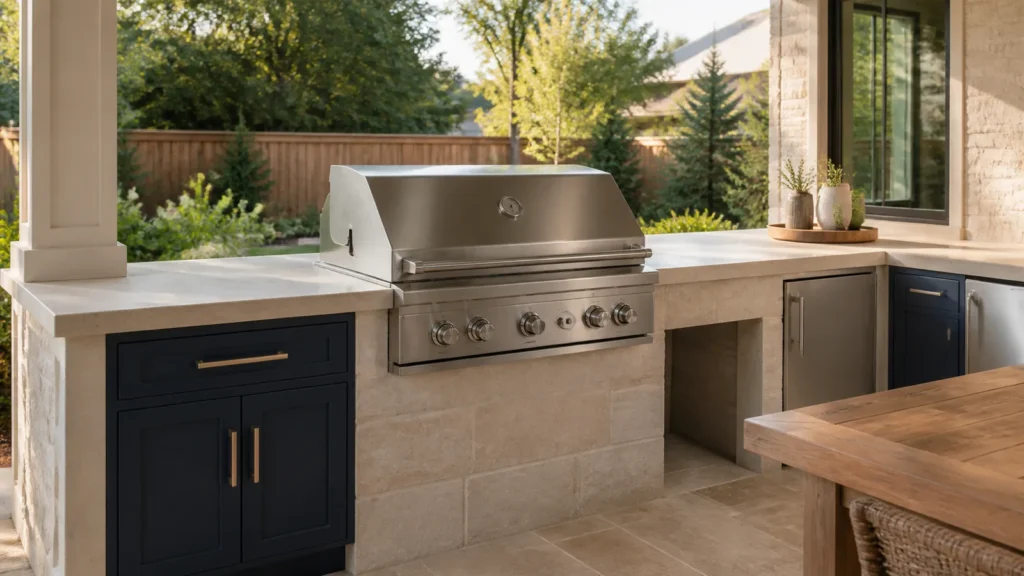
Choosing a built-in grill is not simply a matter of matching a guest count to a width. The grill becomes part of a permanent outdoor-kitchen assembly, so its cooking capacity, appliance body, required opening, clearances and supporting services all have to work together before stone or cabinetry is finalized.
This guide helps you narrow the field to compact, medium or large-format grills and identify nominal size classes worth investigating. It does not generate construction dimensions. The installation manual and specification sheet for the exact model must control the final cutout, enclosure, clearances, ventilation, fuel and electrical planning.
For broader project planning, visit Larmine’s Outdoor hub or browse the complete collection of homeowner guides.
Built-In Grill Fit Worksheet
Describe how you cook and how much of the island must remain available for work and storage. The result is a planning category—not a construction specification or product recommendation.
Five Measurements That Are Not Interchangeable
A built-in grill listing can place several different numbers on the same page. Treating them as one measurement is where expensive planning errors begin.
- Nominal grill width is a product-class label such as 32 or 36 inches. It is useful for shopping, not for cutting stone.
- Overall appliance dimensions describe the physical grill body, control panel and sometimes the hood in specified positions.
- Primary cooking surface is the main usable grate. It should be compared separately from total cooking area, which may include warming racks.
- Manufacturer-required cutout is the finished opening specified for the exact model. Width, depth, height, support and tolerances can vary between models with the same nominal label.
- Required clearances govern separation from surfaces, lid movement and other installation conditions. They are not extra cutout inches and cannot be inferred from nominal width.
These original diagrams are simplified educational concepts. They are not manufacturer-approved installation drawings and are not to scale.
How the Common Nominal Size Classes Differ
The ranges below are shopping categories, not standards. Manufacturer naming varies, and a 30-inch model from one line may be closer in real capacity to another brand’s 32-inch model than its name suggests.
| Nominal class | Worth investigating when | Potential trade-off | Verify before committing |
|---|---|---|---|
| About 30 inches | The island is compact, routine cooking is modest, and usable prep area matters more than maximum grate width. | Large mixed menus may require batches or fewer simultaneous zones. | Primary grate, burner arrangement, hood movement and exact cutout. |
| About 32 inches | You want a common medium format with room for multiple zones without allowing the grill to consume the entire island. | The nominal number may understate overall body width. | Exact overall dimensions, cutout and accessories for the model. |
| About 36 inches | You cook proteins and sides together, entertain regularly, or want more independent temperature zones. | It can reduce landing, storage or secondary-appliance space in a shorter run. | Actual primary area; do not assume every 36-inch grill has the same capacity. |
| About 38 inches | A particular manufacturer line offers the features and cooking layout you want between its medium and large formats. | A less common nominal class may narrow future drop-in replacement choices. | Model-specific opening and long-term service/parts strategy. |
| About 42 inches and larger | You host frequently, need several zones or regularly cook high-volume mixed menus. | Higher purchase and operating commitment plus less room for prep and accessories. | Island proportion, lid clearance, enclosure requirements and actual usable grate. |
Lowe’s current U.S. category guide describes roughly 30–36 inches as a medium built-in range and notes that much larger models are available for frequent large-group cooking. That is helpful category context, but it is not a sizing rule. A household of four may still value a wider grill for separate heat zones; a frequent host may prefer a medium grill plus a dedicated side burner or griddle.
Choose Cooking Capacity by Menu, Not Guest Count Alone
Guest count is easy to ask and easy to overvalue. Two cooks feeding the same eight people can need very different grills. Burgers cooked in batches use the grate differently from fish, vegetables and a delicate side dish held at separate temperatures.
Compare primary cooking area
Use the main grate measurement when comparing how much food can cook directly. A manufacturer’s “total cooking area” may add a warming rack or secondary surface. Those areas can be useful, but they are not automatically interchangeable with the primary grate.
Count useful heat zones
A wider grill can make indirect cooking and temperature separation easier when burner controls and firebox design support it. Burner count is still only one part of performance. Do not infer evenness, recovery or searing ability from width or advertised BTU alone.
Account for rotisserie clearance and workflow
If rotisserie cooking matters, confirm that the exact model includes or supports the required burner, motor, spit and storage. Consider where hot components will be handled. A feature that expands cooking options can also require counter and storage planning.
Decide whether a side burner is replacing grill width
A side burner can move sauces, boiling and sautéing off the main grate. In some kitchens, a medium grill plus a side burner creates a more useful cooking station than a larger grill with no adjacent landing area. In others, the side burner simply consumes space better reserved for preparation.
Plan the Whole Island, Not the Largest Grill That Fits
An outdoor kitchen is a sequence of activities: ingredients arrive, food is prepared, raw items move to heat, cooked items land safely, and tools return to storage or cleanup. A grill that technically fits can still produce a frustrating kitchen if it leaves nowhere to set a tray.
Protect prep and landing space
Counter beside the grill supports raw-food separation, trays, tools and finished food. Generic landing-space suggestions can help during early layout discussions, but the final design must reconcile the grill manual, countertop system, appliance doors, traffic and applicable local requirements.
Reserve access and storage
Access doors, drawers, grease management, shutoff access and service paths must not become afterthoughts. Storage under or beside a grill is not automatically appropriate for every item or fuel configuration. Follow the exact appliance and enclosure documentation.
Coordinate refrigeration before ordering
An outdoor refrigerator adds width, door swing, ventilation and electrical considerations. Decide whether it belongs in the same run before allowing a larger grill to occupy the available cabinetry. Use the refrigerator’s own installation instructions as a separate set of requirements, and review Larmine’s Outdoor Refrigerator Buying Guide before finalizing the appliance opening.
The Permanent Cutout Problem
A freestanding grill can be moved or replaced as one assembly. A built-in grill is coordinated with a finished opening, support structure and utilities. If a future grill has a different flange, control panel, depth or cutout, replacement may require trim, an adapter solution approved for the equipment, cabinetry changes or countertop work.
Select the grill before final fabrication
Record the exact model number, fuel version and revision of its documentation. Share the manufacturer’s cutout page and full installation manual with the outdoor-kitchen designer, fabricator and qualified installers. Do not fabricate from a retailer filter labeled “36 inch.”
Plan for flexibility without promising compatibility
You can compare how much structure surrounds the opening, whether the manufacturer offers compatible jackets or trim, and how service access is preserved. You cannot guarantee that another brand—or even a future generation from the same brand—will fit unchanged.
Keep the documents
Save the model’s specification sheet, installation manual, purchase record and photographs of concealed services before the enclosure is closed. This information can help with service and future remodeling. It does not replace a professional inspection or current code review.
Fuel, Enclosure and Installation Safety
Choose the correct natural-gas or propane model specified by the manufacturer. Never assume the fuels are interchangeable or perform an unapproved conversion. Gas-line sizing, regulators, shutoffs, leak testing and connections belong with qualified professionals following the appliance instructions and adopted codes.
Built-in grills require enclosures designed for the specific appliance and fuel arrangement. Combustible construction, insulated or zero-clearance jackets, enclosure ventilation, cylinder storage, lid clearance and overhead conditions are model-specific. A jacket that is approved for one product family must not be assumed suitable for another.
Some grills also require electrical power for ignition, lighting, rotisserie motors or controls. Follow the exact electrical instructions and use licensed professionals where required. Confirm permits and local requirements with the authority having jurisdiction before construction.
A Safer Buying and Planning Sequence
- Define the cooking job. Record typical menus, heat zones, household use and real entertaining frequency.
- Map the entire island. Include prep, landing, storage, refrigeration and optional side cooking—not only grill width.
- Shortlist size classes. Use the worksheet to investigate compact, medium or large-format products.
- Compare actual primary cooking areas. Separate the main grate from total area and marketing capacity claims.
- Select the exact model and fuel version. Do this before construction openings are finalized.
- Download current documentation. Confirm overall dimensions, cutout, clearances, enclosure, ventilation, utility and accessory requirements.
- Coordinate qualified trades. Review the model with the designer, fabricator, electrician and gas professional as applicable.
- Fabricate from approved documents. Do not transfer a nominal width or another model’s opening.
- Keep records. Store manuals and photographs for service and future replacement planning.
Real Product Examples—For Scale, Not Rankings
Larmine did not physically test the products below. They are included only to demonstrate how current manufacturers label size classes and publish model-specific documentation.
Napoleon Built-In 500 Series 32, BI32PSS
The current U.S. product page calls this a 32-inch grill, lists a 33.5-inch overall width and identifies a 29.5-by-18-inch main cooking area. The page links its product manual. Those separate numbers demonstrate why the nominal name cannot become the countertop opening.
Napoleon Built-In 700 Series family
The current U.S. line presents 32-, 38- and 44-inch steps with different burner and capacity configurations. This illustrates that manufacturers may build their own progression rather than using only 30, 36 and 42. Compare the exact model and documentation, not the nearest familiar label.
Lynx and Blaze documentation
Lynx maintains product documentation by model, including 36-inch Sedona specifications, while Blaze publishes product-specific manuals for its 32-inch built-in lines. These are useful sources at the model-selection stage; neither should be generalized into universal installation dimensions.
Common Mistakes to Avoid
- Buying the largest grill the island drawing can contain.
- Using nominal width as the finished cutout width.
- Comparing total cooking area without checking the primary grate.
- Assuming equal widths mean equal burner layouts or heat zones.
- Finalizing stone before selecting the exact fuel-specific model.
- Forgetting hood movement, service access and accessory storage.
- Copying clearances, jackets or ventilation details from another model.
- Assuming a future replacement will fit because it has the same nominal size.
- Using a freestanding grill in a built-in enclosure unless the manufacturer explicitly approves that configuration.
Frequently Asked Questions
Is a 30-inch built-in grill big enough for a family?
It can be, especially when routine meals use one or two heat zones and island space is limited. Compare the actual primary grate and burner layout. A household count alone cannot determine whether a specific 30-inch model suits the way you cook.
Should I choose a 32- or 36-inch built-in grill?
Investigate both if they fit the overall island plan. A 36-inch class may offer more grate or zone flexibility, but the benefit is not automatic. Compare primary cooking area, controls, burner configuration, features, exact body dimensions and the counter space each option leaves.
Is a 42-inch grill too large?
Not for every kitchen. It may be appropriate for frequent high-volume cooking with multiple zones. It may be oversized when it removes necessary prep, landing, storage or appliance space. Judge the whole cooking workflow rather than the grill in isolation.
Are built-in grill cutout dimensions standard?
No. Even products with the same nominal width can require different openings, supports, tolerances and clearances. Use only the current installation documentation for the exact model and fuel version.
Can I replace a built-in grill with another brand of the same size?
Possibly, but the nominal label does not establish compatibility. Compare the new unit’s entire specification and installation package with the finished enclosure. Countertop or cabinetry modification may be necessary.
Do I need an insulated jacket?
That depends on the exact grill, enclosure materials and manufacturer instructions. Use only a jacket or liner approved for the relevant model and follow its installation documentation. Do not infer the requirement from grill width.
Should I choose natural gas or propane first?
Fuel selection affects the exact product version and installation planning, so resolve it before ordering and before utilities are finalized. Consult qualified professionals; do not assume a conversion is permitted.
Sources and Method
Larmine did not physically test or install grills for this guide. We reviewed current U.S. manufacturer product pages and model documentation, then used retailer guides for category and purchasing context. Product availability and documentation can change; verify the exact model immediately before purchase and construction.
- Napoleon — Built-In 500 Series 32 BI32PSS product page and manual access
- Napoleon — Built-In 700 Series 32 product page and documentation
- Napoleon — model-specific zero-clearance liner context
- Blaze — LTE PRO 32-inch model manual
- Lynx — official product-documentation library
- Lowe’s — U.S. built-in gas grill category guide
- Lowe’s — built-in grill replacement and setup safety context
- BBQGuys — grill sizing and cutout context
Choose the appliance before the opening
Use the worksheet to shortlist a planning class, then obtain the current specification sheet and full installation manual for every exact model under consideration.
Return to the worksheet