
Editorial disclosure: Larmine independently researched this guide. It contains no affiliate links, and no manufacturer paid for inclusion. Product examples explain specification differences; they are not rankings or claims of hands-on testing.
An outdoor refrigerator can be a convenient place for drinks, garnishes, ingredients and leftovers—but stainless steel, a compact cabinet and a front grille do not by themselves prove that a unit belongs outside or inside an island. The correct choice is the model whose documented intended use, storage function, ventilation, operating conditions, opening dimensions, electrical requirements and warranty all match the planned installation.
This outdoor refrigerator buying guide gives you a specification-first way to build a shortlist. It does not create construction dimensions or approve an installation. The current specification sheet, installation manual and warranty for the exact model must control the final decision.
Quick answer: choose documentation before features
Start by deciding whether you need safe storage for perishable food or mainly chilled beverages. Then confirm that the exact model is explicitly intended for outdoor use and for built-in installation if it will be enclosed. Measure the available opening, but do not buy from exterior dimensions alone: compare that opening with the manufacturer’s cutout, ventilation, clearance, door-swing and electrical instructions. Finally, verify the allowed ambient conditions and whether the warranty covers your intended location.
- Define what will be stored.
- Confirm outdoor use for the exact model.
- Choose built-in or freestanding installation.
- Measure the available opening and access path.
- Verify cutout, ventilation and clearances from the manual.
- Check the manufacturer’s ambient operating limits.
- Test door or drawer movement in the planned location.
- Coordinate the required electrical supply with a qualified professional.
- Read the warranty before ordering.
Outdoor-rated is an exact-model claim
Do not treat “stainless steel,” “garage-ready,” “commercial style” or “front vented” as synonyms for outdoor-rated. The manufacturer must identify the exact model for the intended outdoor use. A model family can contain indoor and outdoor variants with similar names, dimensions and appearance.
Outdoor conditions can include greater temperature swings, moisture, dust, salt air and direct or indirect weather exposure. The appropriate construction and operating envelope therefore vary by model. Even an outdoor model may require a covered location or have limits that make it unsuitable for a particular climate. Verify intended use in the current product page, specification sheet and installation or use-and-care manual.
Refrigerator, beverage center or wine reserve?
The cabinet shape can hide an important functional difference. A refrigerator intended for food storage is not automatically equivalent to a beverage center or wine reserve, but the marketing category name alone neither proves nor disproves suitability for a specific storage use. If you plan to store meat, dairy, prepared dishes or other perishables, verify the exact model’s manufacturer-stated intended use, temperature capability, relevant specifications or listing, and current documentation.
The U.S. Food and Drug Administration advises keeping a refrigerator at 40°F (4°C) or below and checking it with an appliance thermometer. A beverage-focused appliance whose documented temperature range does not reliably support that requirement should not be treated as food storage simply because cans and shelves fit inside.
| Appliance type | Useful when | Verify before buying |
|---|---|---|
| Outdoor refrigerator | You need documented refrigeration for food, beverages or mixed storage. | Temperature performance, intended use, outdoor suitability and shelf/drawer layout. |
| Outdoor beverage center | Drinks are the primary purpose and bottle/can organization matters. | Whether the exact model’s intended use, temperature capability and documentation support any planned food storage. |
| Outdoor wine reserve | Wine storage temperature and bottle presentation are the priority. | Allowed outdoor conditions, temperature zones, intended use and whether exact-model documentation supports any planned perishable storage. |
| Refrigerator drawers | Separate access, organization or a panel-ready integrated appearance matters. | Drawer extension, panel requirements, usable volume and exact opening dimensions. |
Built-in versus freestanding: follow the permitted installation
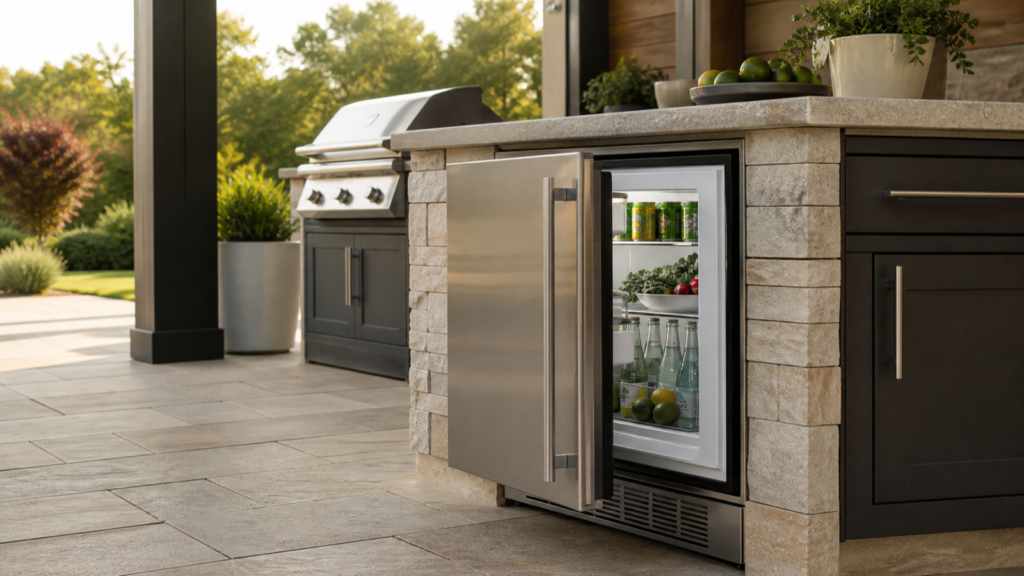
A built-in refrigerator is designed for an installation described by its manufacturer, commonly beneath a counter or inside an appliance opening. A freestanding refrigerator needs the airflow and spacing specified for stand-alone use. Enclosing a freestanding unit can trap heat or violate its instructions.
Front ventilation is an important clue, but it is not blanket permission to place a unit in any enclosure. A front grille does not answer required side, rear or top clearances; toe-kick conditions; support; moisture exposure; or access for service. Confirm that the exact model is approved for built-in use and build the opening from its installation document.
Exterior dimensions are not cutout dimensions
Product width, height and depth describe the appliance body. Cutout dimensions describe the opening the manufacturer expects. Those numbers can differ because of tolerances, hinges, handles, leveling legs, ventilation, cord routing or panel requirements. Never subtract a guess from the cabinet opening or assume that every appliance sold as “24 inch” uses the same cutout.
- Overall width: physical cabinet or product dimension.
- Cutout width: required finished opening for that model.
- Overall depth: may or may not include a handle, plug, door or panel.
- Clearance: space required for ventilation, installation or movement; it is not automatically part of the cutout.
- Access path: gates, stairs and turns the packaged appliance must pass before reaching the opening.
Perlick’s current documentation illustrates the distinction: its 24-inch undercounter families list overall and opening dimensions separately. Sub-Zero likewise publishes overall dimensions, installation illustrations and model-specific panel requirements for its outdoor refrigerator drawers. These examples are not universal dimensions; they show why the exact documents matter.
Ventilation must match the exact enclosure
Refrigeration moves heat from inside the cabinet to the surrounding environment. Blocking the route specified for that heat can reduce performance and stress components. Check where the model takes in and exhausts air, whether the front grille must remain unobstructed, and whether rear, side or top space is required.
Do not copy a vent opening from another brand, assume that a decorative toe kick can cover the grille, or treat “zero clearance” as a generic category. If an island designer proposes ventilation beyond the appliance itself, reconcile that design with the refrigerator instructions and the broader enclosure system.
Check ambient conditions—not just the thermostat setting
The temperature you select inside the refrigerator is different from the ambient operating range around it. Outdoor models are not identical: acceptable heat, cold and weather exposure can vary substantially. A covered patio in a mild climate and an exposed island in a freeze–thaw or extreme-heat region are different installations.
Use the exact manual to verify allowed ambient conditions, winterization or shutdown instructions, and any restrictions on direct rain or sun. Do not rely on an editorial article—including this one—for a universal outdoor temperature range. If the documentation does not answer the question, ask the manufacturer in writing before ordering.
Capacity is usable organization, not only cubic feet
Cubic-foot capacity is useful for comparing broad classes, but your storage pattern determines whether the interior works. Count upright bottles, wide platters, condiment containers and ingredients you actually expect to use. Adjustable shelves can be more valuable than a small increase in headline capacity; drawers can improve separation but may limit tall items.
- For beverages, check can, bottle and upright-container fit rather than marketing capacity alone.
- For mixed food storage, look for practical shelf spacing and temperature monitoring.
- For drawers, confirm full extension and the space needed to remove bins for cleaning.
- For entertaining, preserve prep counter and storage instead of automatically buying the largest appliance that fits.
Door swing and service access
A refrigerator can fit the opening and still be frustrating. Draw the open door or extended drawers on the plan. Check conflicts with grill handles, adjacent doors, walls, seating, narrow walkways and countertop overhangs. Confirm whether the hinge is reversible for the exact model and whether reversal changes ordering, clearances or panel selection.
Also plan how the unit can be removed for service without dismantling fixed countertops. The installation instructions may address leveling, anti-tip provisions, panel removal or access to the plug. Preserve those requirements rather than optimizing only for a flush appearance.
Electrical planning belongs with the model and local requirements
Confirm voltage, frequency, receptacle type, circuit guidance, cord position and any dedicated-circuit language in the exact manual. Outdoor electrical work also has moisture and shock-protection considerations. The U.S. Consumer Product Safety Commission advises GFCI protection and weatherproof covers for outdoor outlets, while adopted codes and the authority having jurisdiction control the actual installation.
Have a qualified electrician coordinate the appliance instructions with the planned location. Do not use an extension cord or alter a plug unless the manufacturer explicitly permits the arrangement and applicable requirements are satisfied.
Covered does not automatically mean protected enough
A roof can reduce direct rain and sun, but wind-driven moisture, humidity, temperature extremes, debris and coastal salt exposure can remain. Likewise, “outdoor-rated” does not mean an appliance can sit in every uncovered location. Match the manufacturer’s exposure and environmental limits to the real site.
If corrosion is a concern, verify cabinet, fastener and component information rather than assuming every stainless surface uses the same alloy. Cleaning guidance can also differ: products that are safe for a stone counter may damage stainless finishes, seals or controls.
Warranty verification is part of fit
Read the current warranty for exclusions tied to outdoor use, commercial use, climate, improper ventilation, nonapproved panels, installation, corrosion or maintenance. A retailer description cannot expand the manufacturer’s warranty. Save the product page, specification sheet, installation manual, warranty and model/serial information with the purchase record.
Model examples: documentation differences, not rankings
Larmine did not physically test the examples below. They demonstrate why product type and documentation must be read at model level.
Sub-Zero ID-24RO outdoor refrigerator drawers
Sub-Zero identifies the ID-24RO as outdoor refrigerator drawers and publishes its overall dimensions, capacity, electrical information and installation guide. The manufacturer also states that the outdoor model requires its outdoor stainless-steel accessory panels; other panels have not been tested for outdoor use. This is a useful reminder that a panel-ready appearance does not permit an arbitrary exterior panel.
Perlick outdoor undercounter refrigerator
Perlick publishes separate refrigerator, beverage-center and wine-reserve configurations, along with specification sheets, installation instructions and warranty documents. That separation demonstrates why a similar 24-inch cabinet does not establish the same storage function. The current outdoor-model page should be matched to the exact model number before specifications are used.
Kalamazoo Arcadia 15-inch outdoor refrigerator
Kalamazoo’s current model page identifies multiple left- and right-hinge variants, finish options and model-specific resources. It illustrates how hinge direction and finish configuration can become order-level decisions rather than adjustments made after the island is finished. Its inclusion here is editorial only; Larmine currently has no affiliate link in this article.
Common outdoor refrigerator buying mistakes
- Buying from the stainless-steel appearance instead of the intended-use statement.
- Treating front ventilation as universal built-in approval.
- Using exterior dimensions as the finished opening.
- Assuming every “24-inch” model has interchangeable cutout dimensions.
- Choosing a beverage center for perishables without verifying its intended function and temperature performance.
- Ignoring the manufacturer’s ambient operating range.
- Blocking the front grille with trim or a decorative toe kick.
- Forgetting door, drawer and service-removal clearance.
- Finalizing cabinetry before selecting the exact model and hinge orientation.
- Assuming outdoor installation is covered by warranty.
A safer buying sequence
- Define the storage job. Decide whether perishables, beverages, wine or mixed storage will be used.
- Measure the real site. Record opening width, height and depth plus delivery path, door swing and adjacent obstacles.
- Shortlist only documented outdoor models. Match the intended exposure and installation type.
- Download current documents. Use the specification sheet, installation manual, use-and-care guide and warranty for the exact model.
- Compare opening and ventilation. Do not infer either from nominal size or another product.
- Check climate suitability. Confirm ambient conditions and seasonal instructions.
- Coordinate electrical work. Give the documentation to the qualified professional before cabinetry is finalized.
- Confirm the order configuration. Model, hinge, finish, panel and accessories should match the plan.
- Fabricate only after verification. The selected model documentation controls the opening.
- Keep the records. Preserve manuals, warranty, receipts and photographs for service or replacement.
Frequently asked questions
Can I use an indoor mini fridge in an outdoor kitchen?
Do not assume so. Use a model only where its manufacturer permits it. An indoor-only unit may have incompatible temperature, moisture, ventilation and warranty conditions even when placed under a covered counter.
Does an outdoor refrigerator have to be front vented?
Not universally. Front ventilation is common for built-in undercounter models, but the exact model must be approved for the planned installation. Freestanding products may use other airflow arrangements and require open space around them.
Are outdoor refrigerator cutouts standard?
No. Nominal width is a shopping category, not a construction dimension. Compare the manufacturer’s current opening requirements for the exact model and configuration.
Can a beverage center store food?
Only if its documented intended use and temperature performance support the food being stored. FDA consumer guidance calls for refrigerator temperatures at 40°F or below. Verify the appliance specification rather than assuming every cold cabinet is a food refrigerator.
What size outdoor refrigerator should I buy?
Choose from usable storage needs and the verified opening—not a universal household-size chart. Compare shelf or drawer organization, exterior dimensions, cutout, door movement and the counter/storage space the appliance consumes.
Can an outdoor refrigerator stay outside in winter?
That is model- and climate-specific. Check the manufacturer’s minimum ambient condition, winterization or shutdown instructions, exposure limits and warranty. Do not assume that “outdoor” means operating through every freeze.
Sources and method
Larmine reviewed current official manufacturer pages, installation resources and U.S. consumer-safety guidance. Specifications and documents can change; retrieve the current files for the exact model immediately before purchase and construction.
- Sub-Zero — ID-24RO outdoor refrigerator drawers
- Sub-Zero — outdoor drawer panel installation guidance
- Perlick — HH24RO outdoor refrigerator and linked documentation
- Perlick — undercounter refrigeration installation and operation instructions
- Kalamazoo — Arcadia 15-inch outdoor refrigerator
- U.S. FDA — Refrigerator Thermometers: Cold Facts About Food Safety
- U.S. CPSC — Home Electrical Safety Checklist
- BBQGuys — outdoor refrigeration category context
Plan the appliance before the opening
Use the Fit Checker to identify missing specifications. If you are still choosing the cooking appliance and deciding how much island space remains for refrigeration, use Larmine’s Built-In Grill Size Guide and planning worksheet. For more outdoor planning resources, visit the Outdoor hub or browse all Larmine Guides.