
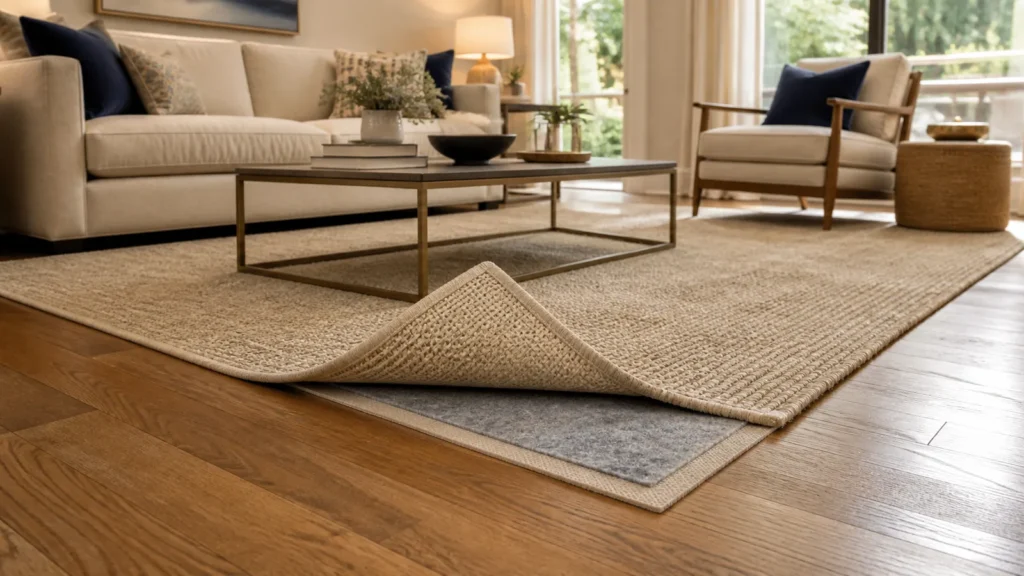
The best rug pad for a hardwood floor is not simply the thickest or cheapest option. It should be compatible with the exact floor finish, provide the amount of grip your rug needs, fit beneath the rug without showing, and leave enough clearance at doors and transitions.
For many hardwood-floor applications, natural rubber, dense felt, or a felt-and-natural-rubber combination are useful starting categories. Natural rubber emphasizes grip; felt emphasizes cushioning; a felt-and-rubber pad combines both functions. But the floor manufacturer’s care and warranty instructions, the rug maker’s requirements, and the specifications of the exact pad should control the final decision.
In this guide
- The safest decision order
- Rug pad materials compared
- Felt vs. rubber vs. combination pads
- How thick a rug pad should be
- How to size and trim a rug pad
- Situations that need extra caution
- A room-by-room selection framework
- Buying checklist
- Frequently asked questions
Start with compatibility—not thickness
A rug pad sits in direct, long-term contact with the floor finish. That makes compatibility the first question, ahead of comfort or price.
Bona’s current homeowner guidance recommends felt or natural rubber pads for wood floors and warns that some inexpensive PVC products can interact with finishes. At the same time, flooring instructions are not identical across brands and products. Shaw, for example, directs owners to follow the instructions for their specific floor and notes in its hardwood-care material that rugs and the area below them require routine inspection and cleaning.
Use this order:
- Identify the floor. Confirm whether it is site-finished hardwood, prefinished solid wood, engineered wood, or another hard-surface product that only looks like wood.
- Check the floor documentation. Review the current care guide and warranty for restrictions involving rubber, latex, PVC, adhesives, color transfer, radiant heat, moisture, and newly applied finishes.
- Check the rug instructions. Some washable or modular systems require a proprietary pad or base. A handmade rug may have different support needs than a machine-washable cover.
- Check the exact pad. Do not rely only on a broad label such as “rubber” or “felt.” Verify the material composition, approved floor types, thickness, trimming instructions, and warranty.
- Choose grip and cushion. Only after compatibility is established should you decide how much slip resistance and softness the room needs.
Important: “Safe for hardwood” is a product-specific claim, not a universal guarantee for every wood species, coating, stain, or newly refinished floor. When documentation conflicts or is incomplete, ask the floor or finish manufacturer before placing the pad.
Rug pad materials compared
| Material category | Main strength | Main limitation | Often considered for | Verify before buying |
|---|---|---|---|---|
| Natural rubber | Strong grip at a relatively low profile | Usually less cushioning than thick felt | Small rugs, runners, flatweaves, busy paths, door-clearance areas | Exact rubber composition and approval for your floor finish |
| Dense felt | Cushioning, support, and sound absorption | Felt alone may not grip a lightweight rug | Large rugs held by furniture, thicker rugs, comfort-focused rooms | Whether the rug is sufficiently anchored and whether movement is possible |
| Felt + natural rubber | Combines cushion with grip | More thickness and usually higher cost than a thin grip pad | Living-room rugs, dining rugs, lighter large rugs | Total finished height and which side faces the floor |
| PVC or synthetic mesh | Low cost and grip can be strong | Formulations vary; some floor-care sources warn of sticking, staining, or finish interaction | Only when the exact floor and pad manufacturers approve the combination | Material disclosure, floor compatibility, warranty, and ventilation/curing requirements |
| Foam or memory foam | Soft feel and cushioning | May not provide sufficient grip; compatibility varies | Low-traffic comfort applications when specifically approved | Floor finish, rug stability, compression, and total thickness |
| Jute or mixed fiber | Can provide a firm natural-fiber feel | Grip and composition vary; fibers or additives may not suit every finish | Large, well-anchored rugs when approved | Full material composition and whether a separate grip layer is needed |
This table compares categories, not individual products. Two pads sold under the same broad material name can use different binders, coatings, adhesives, densities, and warranties.
Felt vs. natural rubber vs. felt-and-rubber
Natural rubber: prioritize grip and a low profile
Natural rubber is a useful category when the rug is light, small, narrow, or likely to move. It can suit a runner, entry-adjacent rug, flatweave, or any location where a thick edge would interfere with a door.
Natural rubber is not automatically compatible with every finish simply because it is “natural.” Read the pad maker’s approved-floor list and the flooring manufacturer’s restrictions. Also distinguish a purpose-made natural-rubber rug pad from a rug with an unspecified rubberized backing; their construction and floor contact can differ.
Consider natural rubber when:
- Grip matters more than plushness.
- The rug is a runner, flatweave, or smaller accent rug.
- A door or transition limits total height.
- Furniture does not reliably anchor the rug.
Check carefully when:
- The floor was recently installed, coated, or refinished.
- The room has radiant heat.
- The product does not disclose its full material or approved floor types.
Felt: prioritize cushioning beneath a stable rug
Dense felt adds support and comfort without relying on a grippy surface. It is often considered beneath large rugs that are already stabilized by their weight and by furniture.
Felt alone is not the best default for a loose runner or a small, lightweight rug. A cushioned pad that moves with the rug can still create an unstable surface. RugPadUSA’s current product guidance similarly distinguishes felt pads intended for larger rugs from non-slip products intended for runners and small rugs.
Consider felt when:
- The rug is large and substantially anchored by furniture.
- Cushioning and acoustic softening matter.
- The rug does not need a dedicated non-slip layer.
Check carefully when:
- Corners move, wrinkle, or curl.
- The rug sits in an active path.
- A thick pad would reduce door clearance or raise an edge excessively.
Felt and natural rubber: balance cushion and grip
A combination pad typically places felt toward the rug and a natural-rubber gripping layer toward the floor. It can be a practical middle ground for a living-room rug that benefits from both cushioning and resistance to movement.
Do not assume every two-layer pad uses natural rubber. Confirm the backing material, approved surfaces, orientation, and total thickness. If the manufacturer marks one side for the floor, follow that instruction.
Consider a combination pad when:
- A living-room rug is large but not fully anchored.
- The rug is thin enough to benefit from cushioning.
- The seating arrangement creates turning or lateral forces.
- You want one pad to provide both grip and support.
How thick should a rug pad be?
There is no universal thickness for every rug. The practical choice depends on the rug’s pile, size, location, furniture, doors, and the pad maker’s intended use.
Thin or low-profile pads
A thin grip pad can be the better fit beneath runners, flatweaves, small rugs, thick rugs, or rugs near swinging doors. Lower height can reduce the prominence of the edge and preserve clearance.
Around 1/4 inch
For many living-room area rugs, approximately 1/4 inch is a useful starting point because it can add support without creating the height of a plush carpet cushion. Treat that as shopping guidance—not a standard. The exact rug and pad specifications still control.
Around 3/8 inch
A 3/8-inch felt or combination pad can add more cushioning under a larger rug. Check the total height of rug plus pad, especially near doors, floor transitions, recliners, and walking paths. RugPadUSA’s current thickness guidance places 1/4- and 3/8-inch options among its common choices but also notes that thinner profiles are preferable in some high-traffic and clearance-sensitive situations.
About 1/2 inch
A 1/2-inch pad is a comfort-oriented choice, not the automatic “best” choice. Under an already thick or soft rug, additional height and give may make an edge or transition less comfortable to walk across. Use it only when the manufacturer supports the combination and the room geometry, furniture, and traffic pattern make the extra thickness appropriate.
Practical thickness framework
| Situation | Useful starting direction | Why | Must verify |
|---|---|---|---|
| Small rug or runner | Thin natural-rubber grip pad | Movement control with less added height | Exact floor approval and adequate edge stability |
| Flatweave living-room rug | Thin to 1/4-inch combination pad | Grip plus modest cushioning | Door clearance and rug-maker instructions |
| Medium/large living-room rug | About 1/4-inch felt-and-rubber | Balanced grip and support | Furniture anchoring and total height |
| Large, heavy rug anchored by furniture | 1/4- to 3/8-inch dense felt | Cushioning may matter more than grip | Whether felt alone keeps the assembly stable |
| Thick or plush rug | Thin pad or manufacturer-specified pad | Avoid excessive height and softness | Product-specific construction and warranty |
| Rug near a swinging door | Lowest compatible profile | Preserve clearance | Measure rug plus pad at the thickest edge |
These are starting directions, not product approvals. A rug’s construction and the floor maker’s requirements can override them.
How to choose the right rug pad size
The pad normally sits fully beneath the rug rather than aligning flush with its edges. A slightly smaller pad lets the rug taper toward the floor and keeps the pad out of sight.
Current guides do not all express the trimming rule in exactly the same way. Crate & Barrel uses about one inch less on all four sides as a general rule of thumb. RugPadUSA describes subtracting approximately two inches from both the rug’s length and width, which produces about a one-inch inset per side. Thicker pads and very large rugs may require a different inset according to the pad manufacturer.
Example
For a nominal 8 × 10-foot rug, a common starting pad size would be approximately 7 feet 10 inches × 9 feet 10 inches, creating about a one-inch rug border on each side.
But first measure the actual rug. Nominal and finished dimensions can differ, particularly with handmade products, fringed edges, washable covers, and rugs that have changed shape during use.
Safe trimming workflow
- Measure the rug body without tassels or fringe.
- Read the pad maker’s trim allowance.
- Mark the pad so the inset is even around the perimeter.
- Follow the manufacturer’s cutting directions and use a protected work surface.
- Place the cut edge fully beneath the rug.
- Recheck corners and traffic-facing edges after the rug settles.
If the pad contains multiple layers, a grippy coating, or a finished edge, do not cut it unless the manufacturer says it is trimmable.
Situations that need extra caution
Newly installed or refinished hardwood
Do not place a rug or pad until the applicable flooring, coating, or finish instructions permit it. Dry-to-touch time is not necessarily full cure time, and cure schedules differ. Follow the exact product documentation or ask the installer/finish manufacturer. Larmine does not apply one universal waiting period.
Site-finished versus factory-finished floors
A finish applied in the home can have different curing and care requirements from a factory-applied finish. Identify the actual finish when possible. If it is unknown, obtain guidance before committing to a pad that will remain in continuous contact with the surface.
Radiant heat
Confirm that the flooring, rug, and pad are all approved for the floor-heating system and its operating limits. A pad can affect heat transfer, and broad material labels are not enough to establish compatibility.
Washable rugs and proprietary systems
Some washable rug covers are designed to attach to a specific base. Substituting a conventional pad can affect fit, edge behavior, cleaning, or warranty. Follow the system maker’s instructions rather than assuming a generic pad is interchangeable.
Dining chairs, recliners, and rolling furniture
Test movement across the rug edge and over the padded surface. Chair legs can catch an overly thick edge, and a soft pad can behave differently under concentrated loads. Follow furniture and rug instructions; do not use a rug pad as a substitute for a rated chair mat or another purpose-specific product.
Moisture, spills, and cleaning
A pad does not make hardwood waterproof. Blot spills promptly according to the rug and floor-care instructions. Periodically lift the rug, inspect the pad and floor, remove dry debris, and allow the surface to remain clean and dry. Shaw’s current hardwood-care page specifically advises checking and cleaning beneath area rugs.
Rug pad selector: choose by the real priority
Use this decision framework before shopping:
1. Does the floor manufacturer approve the pad material?
- Yes: continue.
- No: do not use that pad.
- Unknown: treat compatibility as unresolved and contact the floor, finish, or pad manufacturer.
2. Does the rug need grip?
- Small, light, flatwoven, or unanchored rugs usually need more grip.
- Large rugs held by substantial furniture may need less grip and more cushioning.
- If movement is observed, do not assume furniture will eventually solve it.
3. How much total height can the room accept?
Measure the rug and candidate pad together at doors, transitions, moving furniture, and busy walking paths. The lowest compatible option may be better than the plushest one.
4. Is comfort or stability the priority?
- Grip first: consider an approved thin natural-rubber pad.
- Cushion first: consider approved dense felt beneath a well-anchored rug.
- Both: consider an approved felt-and-natural-rubber combination.
5. Are there product-specific requirements?
If the rug uses a proprietary base, the floor has a specific warranty restriction, or the pad cannot be trimmed, those instructions override generic buying advice.
What to avoid when shopping
- An unlabeled pad with no material composition.
- A blanket “safe for all floors” claim that is not supported by product documentation.
- Assuming “rubber-backed rug” and “natural-rubber rug pad” mean the same construction.
- Choosing thickness before measuring doors and transitions.
- Using a cushion-only felt pad where the rug visibly moves.
- Cutting a pad that is not identified as trimmable.
- Covering a newly finished floor before the finish maker permits it.
- Leaving spills or dampness trapped beneath the rug.
- Treating customer ratings as proof of compatibility with your floor finish.
Rug pad buying checklist
- Exact flooring product or finish identified
- Current floor care/warranty instructions reviewed
- Exact rug construction and backing checked
- Pad material fully disclosed
- Pad explicitly approved for the floor type
- Grip requirement assessed
- Rug and pad combined height measured
- Door, transition, recliner, and traffic clearance checked
- Actual rug body measured without fringe
- Manufacturer’s inset/trim allowance followed
- Pad orientation confirmed
- Radiant-heat compatibility checked if applicable
- Return policy and product warranty reviewed
- Plan made to inspect and clean beneath the rug periodically
Before choosing the pad, confirm the rug size
A correctly selected pad cannot rescue a rug that is too small for the furniture group or too large for the room. Use Larmine’s Living Room Rug Size Guide & Calculator to test common layouts and measure the seating zone. For a bedroom, use the Bedroom Rug Size Guide because bed width, nightstands, and exposed landing area change the sizing logic.
Choose the rug footprint first
Use the room-size calculator, tape the recommended footprints on the floor, and then select a compatible pad for the rug you actually plan to buy.
Use the Living Room Rug Size CalculatorContinue planning your living room
Compare Larmine’s measurement and product-selection guides before ordering major room elements.
Explore Living Room GuidesFrequently asked questions
What is the best rug pad material for hardwood floors?
Natural rubber, dense felt, and felt-and-natural-rubber combinations are practical categories to evaluate. Natural rubber emphasizes grip, felt emphasizes cushioning, and a combination provides both. The best choice is the exact pad approved by the floor and rug manufacturers for your application.
Is natural rubber safe for hardwood floors?
Purpose-made natural-rubber pads are commonly marketed for hardwood and are recommended as a category by Bona’s homeowner guidance. That does not establish compatibility with every finish. Verify the exact pad against the flooring or finish documentation, especially on a newly installed or refinished floor.
Can PVC rug pads damage hardwood?
Bona warns that some inexpensive PVC pads can interact with wood-floor finishes. PVC products vary, so do not assume every formulation behaves identically. Use only a product whose manufacturer documents compatibility with the exact floor, and follow the floor warranty.
Is felt or rubber better under an area rug?
Felt is better suited to cushioning a large, stable rug; natural rubber is better suited to grip. A felt-and-rubber pad can provide both. The rug’s weight, furniture anchoring, traffic, and available height should decide which function matters most.
Is a 1/4-inch or 3/8-inch rug pad better?
About 1/4 inch is a practical starting profile for many living-room rugs. A 3/8-inch pad adds more cushioning but also raises the rug. Choose after checking rug thickness, doors, transitions, traffic, and manufacturer instructions. Neither thickness is universally better.
Should a rug pad be the same size as the rug?
Usually no. The pad is typically cut slightly smaller so it stays hidden and the rug edges taper toward the floor. A common starting point is about a one-inch inset on each side, but use the exact pad maker’s measuring and trimming instructions.
Do large rugs need non-slip pads?
Not always. A heavy rug anchored by substantial furniture may remain stable on dense felt, while a lighter or less-anchored large rug may benefit from a combination pad. Evaluate actual movement rather than relying only on nominal rug size.
Can I place a rug pad on newly refinished hardwood?
Only after the applicable finish documentation or the finish professional says rugs and pads may be replaced. Cure times are product-specific. Larmine does not recommend a universal waiting period.
How often should I check beneath an area rug?
Set a recurring inspection based on traffic, pets, spills, and the floor-care instructions. Lift the rug often enough to identify debris, dampness, pad deterioration, sticking, or discoloration before it becomes a larger problem. Follow the rug, pad, and floor manufacturers’ cleaning directions.
Sources and methodology
Larmine compared current U.S. wood-floor care guidance, flooring-manufacturer care information, and current rug-pad sizing/material guidance. Manufacturer and retailer guidance is identified as such; it is not presented as a universal flooring standard. Product-specific floor, rug, finish, and pad instructions control where they differ from general guidance.
- Bona U.S. — Best Rug Pads for Wood Floors
- Supports the functions of pads and Bona’s category-level discussion of felt, natural rubber, felt/rubber combinations, and PVC concerns.
- Shaw Floors — Hardwood Floor Care & Maintenance
- Supports checking and cleaning beneath area rugs and following product-specific floor instructions.
- National Wood Flooring Association — Problem Prevention
- Supports the broader need to protect finished wood floors from scratches and maintain them according to appropriate guidance.
- RugPadUSA — How to Choose the Right Rug Pad
- Manufacturer guidance for grip/cushion use cases and common thickness considerations; treated as brand guidance, not a universal standard.
- RugPadUSA — How to Measure Your Rug
- Manufacturer-specific measuring and inset guidance.
- Crate & Barrel U.S. — Area Rug Buying Guide
- Supports the general one-inch-per-side pad inset and consumer comparison of felt, rubber, and combination categories.
Final recommendation
Choose a rug pad by working from the floor upward: confirm the hardwood finish, verify the exact pad’s compatibility, decide whether the rug needs grip or cushioning, and then choose the lowest thickness that performs the intended job without creating clearance or edge problems. For many living rooms, an approved 1/4-inch felt-and-natural-rubber pad is a useful starting category—but the floor, rug, and pad documentation should make the final decision.