
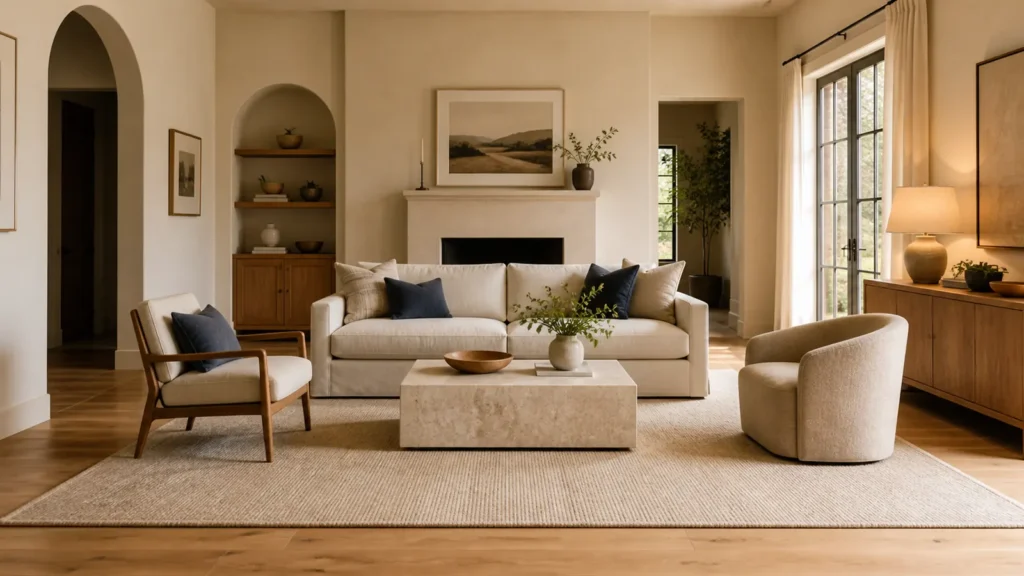
A living room rug should connect the seating group without crowding walls, doors, vents, or walking paths. Use the room-based calculator below to narrow the standard sizes, then tape the full footprint on your floor before ordering.
Living room rug size calculator
Enter the usable room dimensions and choose how much floor you would like visible around the rug. The planner checks common rectangular sizes in both orientations.
This is a planning aid, not a guarantee of fit. It does not know your furniture dimensions, fireplace, vents, doors, traffic paths, or the exact finished size of a product.
Living room rug sizes at a glance
| Nominal size | Often suits | Likely layout | Verify before buying |
|---|---|---|---|
| 5 × 7 or 5 × 8 ft. | Compact apartment seating or a loveseat grouping | Coffee table only, or carefully planned front legs | That the rug does not look isolated between the seats |
| 6 × 9 ft. | Small to medium seating area | Front legs of a compact sofa and chairs | Actual sofa width and chair spacing |
| 8 × 10 ft. | Many medium living rooms | Front legs of sofa and chairs; sometimes all legs on compact pieces | Orientation and the full seating footprint |
| 9 × 12 ft. | Large sofa, sectional, or broader conversation group | Front legs or all legs, depending on furniture depth | Wall border, door swing, vents, and hearth clearance |
| 10 × 14 ft. | Large rooms and open-plan seating zones | Entire seating group on the rug | Delivery access, product weight, and furniture placement |
| 12 × 15 ft. | Grand rooms or a large floating furniture group | All legs on the rug | Whether custom sizing would fit the architecture better |
These are nominal categories, not exact finished dimensions. Always check the product page because hand-finished, woven, or washable systems can vary from the stated size.
Choose the furniture layout before the rug size
The room dimensions set an outer limit, but the seating arrangement decides whether a rug looks connected. Current U.S. retailer guides consistently show three useful starting layouts: all furniture legs on the rug, only the front legs on the rug, or a smaller rug centered inside the seating group.
All legs on
Best for a floating seating group, a large room, or an open-concept zone. Leave enough rug beyond the furniture so pieces do not appear perched on the edge.
Front legs on
A flexible choice for many rooms. The rug should reach every major seat in the conversation group rather than touching the sofa alone.
Interior rug
Can work in a compact space when the rug fills the negative space between seats. Avoid sizing it only to the coffee table.
Original Larmine planning illustrations. They show relationships, not manufacturer-approved dimensions or a scaled room plan.
All furniture legs on the rug
This approach creates the clearest boundary around a seating zone. It is especially useful when sofas and chairs float away from walls. Measure the outside edges of the complete furniture group, then select a rug that extends beyond those edges while maintaining comfortable circulation around the group.
Front legs on the rug
For many conventional living rooms, this is the practical middle ground. The front legs of the sofa and every principal chair rest on the rug, visually connecting the pieces while using a smaller footprint than an all-legs layout. If one chair cannot reach the rug without disrupting the room, reconsider the furniture arrangement before simply buying a larger rug.
Coffee table or interior-only layout
A smaller rug can work when space and budget are constrained, but it should relate to the open area inside the seating group. A rug that is only slightly larger than the coffee table can look disconnected. Use painter’s tape to outline the candidate and view it from the room entrance before deciding.
How to measure for a living room rug
- Draw the usable room. Record wall-to-wall dimensions, then mark door swings, floor vents, hearths, built-ins, and other places the rug should not obstruct.
- Measure the seating group. Note the outside width and depth of the sofa, sectional, chairs, and tables in their intended positions.
- Choose one layout. Decide whether all legs, front legs, or only the interior space will be on the rug.
- Outline standard sizes. Use low-tack painter’s tape to mark at least two candidates at their full nominal dimensions.
- Test movement. Open doors, pull chairs, walk through the main paths, and confirm that the rug will not cover a vent or create an awkward edge in a busy route.
- Check the exact product. Confirm finished dimensions, pile height, pad requirements, care method, return terms, and delivery format before ordering.
Rug sizing for sofas and sectionals
Start with the entire seating footprint, not the sofa’s advertised width. A deep chaise, recliner clearance, side table, or pair of lounge chairs can make the group much larger than one measurement suggests.
Standard sofa with chairs
Place the rug’s long edge parallel to the sofa in most rectangular arrangements. For a front-legs layout, confirm that the rug reaches far enough toward each chair for both front feet to sit securely on it. If the sofa is centered but the chairs fall outside the rug, the composition can feel fragmented.
L-shaped sectional
Use the sectional’s outer width and chaise depth as the starting rectangle. An 8 × 10 may work with a compact sectional, but many larger configurations need 9 × 12 or 10 × 14 to connect the chaise, opposite seating, and coffee table. Rotate both taped footprints before deciding; orientation can matter as much as size.
Reclining furniture
Operate every reclining seat while the taped outline is on the floor. Verify that a rug edge or thicker pad will not interfere with moving feet or create an unstable transition. Follow the furniture and rug manufacturers’ clearance and floor-protection instructions.
Open-concept rooms and multiple zones
In an open plan, measure the living zone rather than subtracting a border from the entire combined room. The rug can define the conversation area without extending into the dining or kitchen path. Align it with the dominant furniture group or an architectural line, not automatically with the center of the full floor plan.
When two rugs are visible together, coordinate scale and color without requiring an exact match. Leave a deliberate transition between zones so the edges do not form a narrow trip-prone strip. If standard dimensions produce awkward boundaries, a custom size may be more coherent than forcing the largest stock option.
Size is only one part of practical fit
Pile height and doors
Measure the clearance beneath nearby doors and cabinets. A rug plus pad can be thicker than expected, especially at bound edges. Do not assume a door will clear merely because the unpadded sample does.
Traffic, pets, and cleaning
Material labels such as wool, cotton, jute, polypropylene, or polyester do not describe every performance characteristic. Compare the exact product’s construction, backing, care instructions, shedding expectations, stain guidance, and suitability for pets or high traffic. A washable rug may require a compatible pad or base and enough appliance capacity for the stated washing method.
Color, pattern, and scale
A large quiet pattern can read differently from a small repeat once it fills the room. Review full-room photography, not only a cropped swatch, and check whether the pattern placement varies by rug size. Obtain a sample when color matching matters; screens and room lighting can shift beige, gray, navy, and natural fibers substantially.
Flooring and safety
Use a rug pad or backing compatible with the exact flooring. Some rubber, latex, PVC, adhesives, or dyes may be restricted by a floor manufacturer or finish. Follow both manufacturers’ instructions, keep edges flat, and address curling or movement promptly.
How to choose a rug pad
A pad can reduce movement, add cushioning, and help protect the floor and rug, but it must match the rug construction, floor finish, and intended use. The pad is normally slightly smaller than the rug so it does not show or create a raised edge. Wayfair’s current guide uses about one inch of rug overhang per side as a starting point, but the exact pad manufacturer may specify a different trim allowance.
- Confirm compatibility with hardwood, luxury vinyl, laminate, tile, or carpet as applicable.
- Check whether the rug itself requires a proprietary pad or base.
- Include pad thickness when checking doors and transitions.
- Trim only when the pad instructions allow it, using safe tools and a protected work surface.
- Recheck the pad periodically for movement, deterioration, or floor discoloration.
Living room rug buying checklist
- Usable room length and width
- Chosen all-legs, front-legs, or interior layout
- Full sofa or sectional footprint, including chaise
- Position of chairs, tables, doors, vents, hearths, and walkways
- Two taped standard-size options tested in the room
- Exact finished rug dimensions and permitted variation
- Material, construction, backing, pile height, and edge profile
- Care instructions and realistic cleaning capacity
- Compatible rug-pad type and finished thickness
- Delivery format, package access, return window, and return-shipping terms
- Sample or swatch reviewed when color accuracy matters
Product categories that deserve comparison
Once size and placement are settled, compare categories rather than jumping to a pattern. Wool rugs can offer resilient fibers and a premium feel but may shed and require product-specific care. Synthetic performance rugs can be practical for traffic or spills, while washable systems prioritize removable construction and cleaning convenience. Natural-fiber rugs add texture but vary in softness, stain response, and suitability for damp cleaning.
Rug pads are a separate buying decision. Compare material, floor compatibility, thickness, grip, trimming instructions, and warranty.
Browse rugs after confirming your size
If you have measured the room, taped the candidate footprint, and confirmed the layout, BENI offers customizable rugs with selectable sizes and design options. Verify the current dimensions, lead time, care information, and return terms on BENI before ordering.
Browse customizable rugs at BENIBuild the room from a reliable footprint
Use the calculator to shortlist sizes, tape both options on the floor, and then explore Larmine’s broader living-room planning resources.
Explore the Living Room hubFrequently asked questions
Is an 8 × 10 rug big enough for a living room?
It can be a strong choice for a medium room when the front legs of the sofa and principal chairs fit on the rug. It may be too small for a deep sectional, wide chair spacing, or an all-legs layout. Tape an 8 × 10 and the next larger size before buying.
Should a living room rug go under the couch?
It does not have to sit under the entire couch, but placing at least the front legs of the sofa and other major seats on the rug is a common way to connect the group. In a large or open room, an all-legs layout can define the zone more clearly.
How much bigger should a rug be than a sofa?
There is no single dimension that works for every room. The rug should relate to the whole seating group and usually extend beyond the sofa rather than ending inside its width. Measure the chairs, chaise, and walking paths as well as the sofa, then test the full footprint with tape.
Should I choose an 8 × 10 or 9 × 12 rug?
Choose based on the taped footprint. An 8 × 10 often supports a front-legs layout in a medium room; a 9 × 12 provides more reach for a sectional, widely spaced chairs, or an all-legs arrangement. Confirm the visible floor border and all obstructions.
Can a rug be too large?
Yes. A rug can crowd walls, block doors or vents, run into a hearth, or make a room read like poorly fitted wall-to-wall carpet. A generous rug can look intentional, but it still needs a deliberate border and safe clearances.
Does the rug need to be centered in the room?
Not always. Center it on the seating zone or dominant furniture arrangement. In an open-concept room, the best center for the living area may differ from the center of the entire floor plan.
Sources and methodology
Larmine compared current U.S. measuring and placement guidance from major home-furnishings retailers, then built an original room-based calculator around transparent geometry. Retailer guidance is useful for understanding common design conventions, but it is not a universal standard and does not replace measuring the actual room or checking the exact product.
- Pottery Barn — How to Use an Area Rug
- Crate & Barrel — Area Rug Buying Guide
- Wayfair — How to Place a Rug in a Living Room
- Wayfair — How to Choose the Right Rug Size
- Ruggable U.S. — Living Room Rugs and Size Guide
Final recommendation
Choose the rug layout before the rug design. Use room dimensions to eliminate sizes that cannot fit, use furniture dimensions to choose between the remaining candidates, and tape the full footprints on the floor. That sequence reduces expensive returns and produces a living room that feels connected rather than decorated around a rug that was chosen in isolation.