
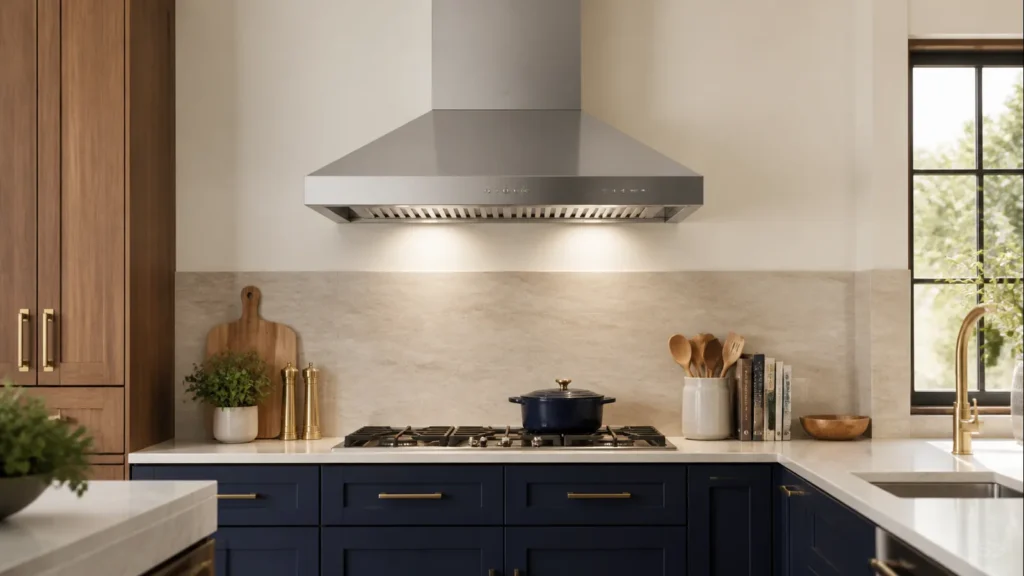
Choosing between a ducted and ductless range hood is not just an installation decision. It changes where captured cooking air goes, which pollutants the hood can address, how much maintenance it needs, and what you should expect from its advertised airflow.
In this guide
- How ducted and ductless range hoods work
- Side-by-side comparison
- Indoor air quality, moisture, grease, and odors
- CFM, capture, noise, and filters
- Installation and apartment constraints
- Gas versus electric cooking
- Makeup air and local-code considerations
- A practical decision framework
How a ducted range hood works
A ducted hood draws air through its grease filters and sends the captured air outdoors through a duct. Depending on the specific hood and kitchen, that duct may route upward through a cabinet or ceiling, or horizontally through an exterior wall.
Outdoor exhaust is the important distinction. When capture is effective, a ducted hood can remove moisture, odors, grease particles, smoke, and other cooking-generated contaminants from the indoor space instead of returning the treated air to the room.
That advantage depends on the complete installation. Hood width and depth, mounting position, fan setting, duct size and route, elbows, termination, replacement air, and whether the cook uses the back burners all affect real-world capture. An impressive blower number cannot compensate for a hood that misses the rising plume or is installed contrary to its instructions.
How a ductless range hood works
A ductless hood—also called a recirculating or non-ducted hood—draws cooking air through filters and returns it to the kitchen. A washable or replaceable grease filter captures some airborne grease. A model-specific charcoal or carbon filter can reduce some odors.
Recirculation is not the same as exterior ventilation. The air remains indoors, so a ductless hood does not provide a path for carrying cooking moisture or combustion pollutants outside. Filter condition also matters: a missing, incompatible, saturated, or incorrectly installed charcoal filter can reduce the odor-control benefit.
Still, “not equivalent to ducted” does not mean “useless.” Where an exterior route is unavailable, a properly sized hood with good coverage, compatible filters, and consistent use can be more useful than an inactive fan or no capture device at all. The U.S. EPA also recommends supplemental steps when an outdoor-vented hood is unavailable, including opening windows or doors when safe, using exhaust fans that do vent outdoors, and considering a portable air cleaner.
Ducted vs. ductless range hoods at a glance
| Decision factor | Ducted hood | Ductless hood |
|---|---|---|
| Air path | Exhausts captured air outdoors | Filters and returns air to the room |
| Cooking moisture | Can remove captured moisture outdoors | Does not exhaust moisture outdoors |
| Particles and smoke | Can remove captured pollutants from the home | Performance depends on filters; ordinary grease/charcoal filters do not make recirculation equivalent to outdoor exhaust |
| Grease | Grease filter captures grease before air enters the duct | Grease filter captures grease before air returns to the room |
| Odors | Captured odors are exhausted outdoors | Compatible charcoal filters can reduce some odors |
| Installation | Requires a compliant exterior route and termination | No exterior duct route; may require a model-specific recirculation kit or charcoal filters |
| Ongoing maintenance | Grease-filter cleaning plus inspection of the exterior path as required | Grease-filter cleaning plus charcoal-filter replacement according to the exact product instructions |
| Typical fit | Homes where a short, practical exterior route can be built | Apartments, condos, rentals, or retrofits where exterior venting is prohibited or impractical |
This comparison describes ventilation modes, not the performance of every hood. A well-designed recirculating hood may capture more at the cooktop than a poorly placed ducted hood, while still lacking the outdoor exhaust function.
Indoor air quality: why exterior exhaust usually wins
Cooking can generate fine particles and other indoor contaminants regardless of whether the appliance is gas or electric. Gas cooking also introduces combustion-related pollutants. The EPA recommends using a range hood, preferably one vented outdoors, and using back burners when possible because they are usually better covered by the hood.
A ducted hood gives captured contaminants an exit from the building. A ductless hood asks filters to do the work, but common grease and charcoal filters have narrower functions. Grease filters are not general-purpose particle or gas-removal systems, and charcoal performance varies by the filter, pollutant, loading, and maintenance.
Moisture, grease, smoke, and odors
Moisture
Boiling, simmering, and steaming add water vapor to the kitchen. A ducted hood can carry captured moisture outdoors. A ductless hood returns the air to the room, so it should not be selected as a moisture-removal solution.
Grease
Both configurations normally rely on a grease filter. Baffle, mesh, and other filter designs have product-specific cleaning instructions. Grease that bypasses or accumulates on a neglected filter can affect cleanliness and performance. Follow the hood manufacturer’s cleaning method and interval rather than assuming every filter is dishwasher-safe.
Smoke and particles
Outdoor exhaust can remove the portion of smoke and particles the hood captures. A standard ductless configuration does not guarantee equivalent particle removal. Some products use additional filtration, but claims must be evaluated for the exact model and replacement filter—not generalized across the category.
Odors
Ducted ventilation removes captured odor-bearing air. Ductless hoods use charcoal or carbon filters to adsorb some odor compounds before recirculation. Those filters are consumables, and there is no universal replacement schedule. Cooking frequency, type of cooking, fan use, and the manufacturer’s filter design all matter.
CFM does not tell the whole story
CFM describes airflow, but it does not by itself tell you how much of the cooking plume a hood captures. A hood must first collect the rising air. Coverage over the burners, mounting position, cross-drafts, and user behavior can be as important as the fan rating.
For wall-mounted hoods, the Home Ventilating Institute uses a recommended reference of 100 CFM per linear foot of range width and a minimum reference of 40 CFM per linear foot. For a 30-inch wall installation, that is a 250 CFM recommended reference and a 100 CFM minimum reference. HVI uses higher references for island installations because they are exposed on more sides. Professional-style cooking equipment may require the appliance manufacturer’s guidance instead.
Those references should not be treated as a universal purchase prescription. Installed airflow can be affected by duct resistance, and a recirculating configuration changes the air path. Compare certified performance where available and use the exact installation instructions.
Size the hood after choosing the ventilation path
Use Larmine’s calculator to separate the HVI minimum reference, HVI-recommended airflow, and any gas-output guideline for your installation.
Use the Range Hood Size & CFM CalculatorNoise: compare certified performance, not adjectives
A quiet hood is more likely to be used consistently, but sound claims need context. Compare the same measurement and operating point. A “quiet” marketing label without a certified sound value does not allow a reliable comparison.
Ducted systems can become noisy when air is forced through undersized, restrictive, or poorly routed ductwork. Recirculating systems also create resistance across their filters. Dirty filters can add restriction. Look for HVI-certified airflow and sound data when available, then verify how the published value applies to the intended installation mode.
Filter maintenance and ownership cost
Ducted and ductless hoods both need grease-filter maintenance. Ductless operation usually adds a recurring charcoal-filter requirement. Before buying, confirm:
- The exact grease and charcoal filter part numbers.
- Whether the charcoal filter or recirculation kit is included or sold separately.
- Current replacement-filter availability from a reliable source.
- The manufacturer’s cleaning and replacement instructions.
- Whether controls or indicators track filter service, and what they actually measure.
Do not assume a “convertible” hood is ready for ductless use out of the box. Broan-NuTone explains that convertible models can support multiple modes, but the required charcoal filter may be a separate purchase. Whirlpool likewise notes that installation requirements differ by configuration.
Installation: when ducting is practical
A ducted installation is easiest to justify when there is a short, direct exterior route with enough space for the manufacturer-specified duct. The best route depends on framing, cabinet layout, electrical work, exterior finish, weather protection, and the permitted termination location.
For a ducted installation, compare common 6-, 8-, and 10-inch configurations in Larmine’s range hood duct size guide before selecting the appliance.
Avoid assuming an existing opening is suitable. A recirculating microwave, an old wall fan, or a duct ending in an attic is not proof of a compliant exterior path. The Building America Solution Center advises routing kitchen exhaust to the outdoors and following the hood manufacturer’s duct and termination requirements.
Apartments, condos, and rentals
In multifamily housing, an exterior penetration may require owner, landlord, condominium, or building approval. Shared walls, fire-rated assemblies, exterior appearance rules, and existing mechanical systems can limit the options.
If exterior ducting is not permitted, a ductless hood may be the practical choice. Verify that the hood is approved for non-ducted operation and identify the correct filter kit. Supplement it with safe source-control practices: use back burners, cover pots when appropriate, clean filters, provide outdoor air when conditions allow, and consider a suitable portable air cleaner for particles.
Convertible range hoods: flexibility with conditions
A convertible hood can be configured for ducted or non-ducted use, but “convertible” is not a performance guarantee. Confirm the exact model supports the intended direction, duct size, recirculation kit, filters, and clearances.
If you expect to add ductwork later, a convertible hood can preserve that option. Buy based on the configuration you will actually use now, however. Published airflow, sound, and filter requirements may differ between vented and recirculating installations.
Gas vs. electric cooking
Both gas and electric cooking can generate particles, grease, moisture, and odors. Gas adds combustion pollutants, which strengthens the case for effective outdoor exhaust. The EPA’s remodeling guidance specifically recommends an outdoor-vented hood over gas cooking equipment.
For high-output gas appliances, follow the cooking-appliance and hood manufacturers’ instructions. Do not select a hood solely by adding BTU ratings to a generic formula. Hood coverage, mounting limits, duct design, replacement air, and local requirements remain part of the system.
Makeup air: avoid the universal 400-CFM rule
Powerful exhaust can depressurize a home if replacement air cannot enter safely. That can affect comfort and, in some homes, combustion-appliance operation. Whether a dedicated makeup-air system is required depends on exhaust capacity, combustion appliances, building tightness, the adopted code edition, local amendments, and system design.
The often-cited 400-CFM number should not be presented as an automatic nationwide rule for every hood and every house. Ask the local code authority and a qualified professional what applies to the actual project before finalizing a high-capacity ducted system.
Which type is better for your kitchen?
Choose ducted when…
- A compliant exterior route is practical.
- Removing moisture and captured pollutants outdoors is a priority.
- You cook frequently, fry, sear, or use gas.
- The project can accommodate duct, exterior, and possible makeup-air work.
Choose ductless when…
- Exterior venting is prohibited or structurally impractical.
- You understand that the unit recirculates rather than ventilates outdoors.
- You can obtain and maintain the exact compatible filters.
- You will use additional IAQ strategies when needed.
A homeowner decision framework
- Confirm the building constraint. Can a duct legally and practically terminate outdoors?
- Define the cooking load. Consider fuel, frequency, smoke, grease, moisture, and the most-used burners.
- Measure the capture zone. Record cooktop width, hood location, mounting range, cabinet depth, and island exposure.
- Size responsibly. Use HVI references and the cooking-appliance and hood documentation.
- Review the complete air path. For ducted, verify duct and termination requirements. For ductless, verify the recirculation kit and filters.
- Check sound and certification. Prefer comparable certified performance data where available.
- Evaluate makeup air and code. Do not turn one national threshold into a universal local rule.
- Budget for ownership. Include installation, finish repairs, filters, and maintenance—not just the hood.
Compare current 30-inch models by kitchen type
Once you know whether you need ducted, ductless, or convertible operation, compare models by installation, airflow, sound, controls, filters, and documentation.
See the Best 30-Inch Range Hoods guideFrequently asked questions
Can a ductless range hood remove smoke?
It can capture some grease and may reduce some visible smoke or particles depending on the exact filtration and capture performance, but a typical grease-and-charcoal setup does not exhaust smoke outdoors and should not be treated as equivalent to a ducted hood.
Does a ductless hood remove moisture?
No exterior moisture-removal path is created. The filtered air is returned to the kitchen, so cooking moisture remains inside unless another ventilation method removes it.
Is a convertible hood always better?
Not automatically. Convertible describes installation flexibility. The hood still needs appropriate capture, airflow, sound performance, filters, maintenance, and correct installation in the selected mode.
Can I convert a ductless hood to ducted later?
Only if the exact model is approved for ducted installation and a compliant exterior route can be built. Verify the model manual and required parts before purchasing.
Do I need a ducted hood with an induction cooktop?
Induction avoids gas-combustion pollutants, but cooking can still generate particles, grease, odors, and moisture. Outdoor exhaust remains the stronger method for removing captured cooking air.
How often should a charcoal filter be replaced?
Use the interval and condition guidance for the exact hood and filter. There is no reliable universal schedule because cooking habits and filter designs vary.
Bottom line
A ducted hood is usually the better choice when a safe, compliant exterior route is feasible. It can remove captured cooking air—including moisture and pollutants—from the home. A ductless hood is a compromise, not a direct substitute: it recirculates air but can still provide useful grease and odor control in kitchens where ducting is not practical.
Choose the mode first, then size the hood and compare models. That order prevents an attractive or high-CFM appliance from locking you into an installation that cannot deliver the ventilation result you expected.
For more kitchen planning resources, visit the Larmine Kitchen hub.
Sources
- U.S. Environmental Protection Agency — Strategies for Improving Indoor Air Quality While Cooking
- U.S. Environmental Protection Agency — Sources of Indoor Particulate Matter
- U.S. Environmental Protection Agency — Addressing Indoor Environmental Concerns During Remodeling
- Building America Solution Center — Kitchen Exhaust Retrofit Duct Guide
- Home Ventilating Institute — How Much Ventilation Do I Need?
- Home Ventilating Institute — Certified Products Directory
- Broan-NuTone — What Does Convertible Mean?
- Whirlpool — What Is a Convertible Range Hood?