
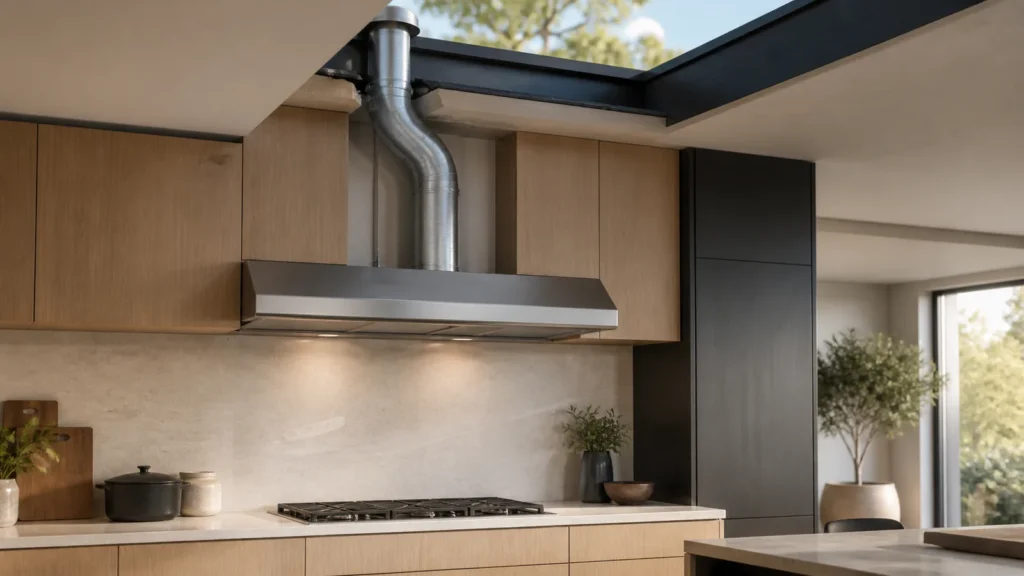
Range hood duct size is not something to choose from a generic CFM chart alone. Six-inch, 8-inch, and 10-inch round ducts all appear in residential installations, but the correct size is the one specified for the exact hood and blower configuration you plan to install.
Affiliate disclosure: This article contains no affiliate links. If eligible affiliate links are added later, Larmine may earn a commission at no additional cost to you. Recommendations will remain based on ventilation performance, installation fit, safety, and manufacturer documentation—not commission.
Quick answer
Many residential range hoods use 6-inch, 8-inch, or 10-inch round metal duct. A 6-inch outlet is common on some mainstream and compact hoods, 8-inch duct appears on many higher-capacity or configurable systems, and 10-inch duct is used by some high-capacity and remote-blower systems. These are examples—not universal CFM limits. Check the installation manual for the exact hood before buying the appliance or cutting cabinets.
Range Hood Duct Size Planning Chart
| Duct configuration | Where it commonly appears | What to verify | Important limitation |
|---|---|---|---|
| 6-in. round | Some mainstream wall, under-cabinet, and compact hoods | Exact outlet, permitted route, transition, and maximum equivalent length | Do not assume every hood below a certain CFM uses 6 inches |
| 8-in. round | Many higher-capacity hoods, liners, and single-blower configurations | Blower choice, outlet adapter, cabinet/ceiling space, and cap size | Do not reduce to an existing 6-in. duct unless the manufacturer permits it |
| 10-in. round | Some high-capacity, dual-, inline-, or remote-blower systems | Full route, framing clearance, transition, termination, and make-up-air review | A smaller downstream section can undermine the intended system design |
| Rectangular | Many under-cabinet hoods and horizontal rear-discharge installations | The exact approved rectangular size and transition in the manual | Matching cross-sectional area alone does not approve an improvised conversion |
This table is planning guidance. It deliberately does not assign a universal CFM capacity to each diameter. Manufacturer examples show why: Wolf documents products that use 6-inch duct and other ventilation products that use 8- or 10-inch duct, while Zephyr manuals assign different outlets to different blower configurations. The model-specific instructions take priority.
Why Range Hood Duct Size Matters
A blower has to overcome resistance from the complete air path: the duct walls, length, elbows, transitions, damper, exterior cap, filters, and any change in size or direction. Making a section smaller can increase resistance and reduce the airflow delivered after installation. It can also contribute to more air noise and turbulence.
This is why advertised CFM and installed performance are not the same thing. A strong blower connected to an undersized or unnecessarily complex route may deliver less useful airflow than its headline rating suggests. Hood depth, width, mounting height, and burner coverage still determine whether the cooking plume enters the hood in the first place.
If you have not estimated the airflow and capture needs for your kitchen, start with Larmine’s Range Hood Size & CFM Calculator. Use that result to narrow the products worth comparing, then use the selected hood manual to finalize the duct.
6-Inch Range Hood Duct
Six-inch round duct appears on many residential hoods, but it covers a wider range of products than a simple CFM chart suggests. For example, Whirlpool documents a 6-inch top outlet on a canopy hood with 350 HVI CFM at high vertical operation. FOTILE documents a 6-inch outlet on a model with several HVI airflow settings up to 580 CFM. Those two products alone demonstrate that “6 inches equals one fixed CFM” is not a defensible rule.
A 6-inch route can be practical in a standard cabinet or wall cavity where the exact hood is designed for it and the run remains reasonably direct. It is not a default that should be imposed on every replacement hood just because an older 6-inch pipe is already present.
Check before using an existing 6-inch duct
- Is it smooth rigid metal rather than dryer-style flex or plastic?
- Does it remain 6 inches for the complete run?
- How many elbows, transitions, and dampers are in the path?
- Does it actually terminate outdoors through a suitable wall or roof cap?
- Does the new hood manual permit 6-inch duct for the selected configuration?
8-Inch Range Hood Duct
Eight-inch duct is common on many higher-capacity residential hoods, inserts, and configurable blower systems. It occupies substantially more cabinet or chase space than a 6-inch pipe, so remodel feasibility matters. A route that looks simple on the appliance specification can conflict with cabinet shelves, joists, plumbing, wiring, or a decorative hood enclosure.
Wolf’s ventilation guidance illustrates model variation by recommending 8-inch or 10-inch round duct depending on the product. Zephyr’s Tempest I manual calls for an 8-inch opening with its single internal blower. These are manufacturer examples, not a universal threshold.
If an 8-inch hood is being considered for a kitchen with an existing 6-inch duct, verify the route before ordering. Replacing the duct may require cabinet modifications, opening a wall or ceiling, changing the exterior cap, and repairing finishes. Choosing a different hood designed for the existing route may sometimes be more practical than forcing a reducer into the project.
10-Inch Range Hood Duct
Ten-inch round duct appears in some high-capacity systems and in installations using large internal, inline, or remote blowers. The larger diameter needs more room through cabinetry, framing, attic or floor assemblies, and the exterior termination. It should be coordinated early in a new kitchen or major remodel.
Zephyr specifies a minimum 10-inch round duct for one Tornado insert configuration, while another configuration in the same product family may use 6 or 10 inches depending on the blower. Broan’s Elite documentation shows 10-inch duct on several inline-blower arrangements, with a specific exception using 8 inches. Again, the system configuration—not a generic label—controls.
Reducing a specified 10-inch path to fit an old smaller opening can add a major restriction. Before assuming a transition will solve the conflict, ask the hood manufacturer whether that change is allowed and what performance consequences it documents.
Range Hood Duct Size vs. CFM
CFM is relevant because it describes air volume at a stated operating or test condition. It is not the only determinant of duct size. The blower type, outlet geometry, pressure capability, duct length, fittings, termination, and the manufacturer’s tested system all matter.
Two hoods with similar advertised CFM can require different outlets. One manufacturer may publish maximum blower airflow, another an HVI-certified installed configuration, and another an “equivalent” marketing figure. A generic chart cannot reconcile those differences reliably.
Planning rule: Use CFM to identify the ventilation class worth considering. Use the exact hood and blower documentation to select the duct. If the two appear inconsistent, do not override the manual with an online chart—ask the manufacturer or a qualified HVAC professional.
Can You Reduce Range Hood Duct Size?
Do not reduce below the manufacturer-specified size merely to connect a new hood to old ductwork. Broan-NuTone advises that reducing the duct below the hood specification restricts performance. Wolf likewise warns that smaller-than-recommended duct can significantly reduce ventilation performance.
Can you reduce an 8-inch outlet to 6 inches?
Only when the exact hood manufacturer documents or approves that configuration. The physical availability of an 8-to-6 reducer does not prove that it is acceptable for every blower. A fitting can connect the pieces while still creating a restriction the system was not designed around.
Can you reduce a 10-inch duct?
Treat a 10-inch specification as a system requirement unless the product documentation provides an approved alternative. A large blower, remote blower, or custom insert may depend on that route to achieve its documented performance.
Can a 6-inch hood connect to a larger existing duct?
A larger downstream duct is a different question from constricting a larger hood outlet. Even then, the transition location, slope, fitting design, cap, and manufacturer instructions matter. Use an approved transition rather than improvising from area alone.
Round vs. Rectangular Range Hood Duct
Round duct provides a continuous shape with no corners and is widely used for vertical routes. Rectangular duct is common where an under-cabinet hood exhausts horizontally through a wall or where cabinet and framing depth limit a round pipe.
Broan-NuTone notes that 3¼-by-10-inch rectangular duct is used on many hoods and describes it as equivalent to 6-inch round for those common applications. That statement does not make every rectangular dimension interchangeable with every round outlet. A model may permit one route but not another, and the required transition introduces its own resistance.
Use the exact rectangular size shown in the hood manual. Do not design a custom conversion solely by matching cross-sectional area; shape, aspect ratio, fittings, velocity, and the blower’s tested configuration remain relevant.
What If Your Existing Duct Is Too Small?
Discovering a 4-inch or undersized duct after buying the hood is one of the most expensive sequencing mistakes in a replacement project. Broan-NuTone explicitly says not to use 4-inch dryer duct or plastic duct for a range hood and directs homeowners to the model specifications.
- Identify the complete route. Confirm diameter or dimensions, material, length, elbows, transition points, and exterior termination.
- Compare it with the candidate manual. Check every permitted vertical and horizontal discharge configuration.
- Price the duct correction before buying. Include cabinet work, wall or ceiling access, exterior cap changes, electrical coordination, and finish repair.
- Compare another hood if needed. A model designed for the available route can be a better project than a more powerful hood installed through a noncompliant restriction.
- Use qualified help for concealed or complex routes. Framing, fire-rated assemblies, roof penetrations, and combustion-safety issues are not good places to guess.
For help deciding whether outdoor ducting is practical at all, compare ducted vs. ductless range hoods before selecting a model.
How Duct Length and Elbows Affect Performance
A straight, short route generally creates less resistance than a long route with several bends. Each elbow, transition, damper, and cap consumes part of the blower’s available pressure. Placing elbows or transitions back-to-back can be especially restrictive; Wolf recommends separation between fittings for its systems, and Zephyr tells installers to minimize transitions and turns.
There is no single maximum duct length that applies to every hood. Manuals assign different equivalent lengths to 45-degree elbows, 90-degree elbows, transitions, and caps. Some systems publish a calculation worksheet; others specify a maximum run or require performance verification.
Count and sketch the fittings before purchase, then use the worksheet for the exact hood. Do not add a universal “extra CFM per elbow” because blower response and fitting penalties are model-specific.
Rigid vs. Flexible Range Hood Duct
Use smooth rigid metal duct unless the exact product and applicable requirements say otherwise. Corrugated flexible duct creates more turbulence and can collect grease and contaminants. Broan-NuTone prefers smooth metal over flexible metal, Zephyr instructs installers to use rigid metal on documented models, and the Building America Solution Center likewise specifies rigid metal for kitchen exhaust retrofits.
Do not substitute dryer-style foil, 4-inch dryer duct, or plastic duct. Seal joints using the method required by the hood and applicable installation instructions, and keep fasteners or obstructions from protruding unnecessarily into the airflow path.
Wall vs. Roof Venting
A range hood may terminate through an exterior wall or roof when the selected route, cap, clearances, weather protection, and local requirements permit it. A wall route can be short when the range is on an exterior wall. A roof route may be necessary for an interior wall or island but adds roof-flashing and access considerations.
The exhaust should reach outdoors, not stop in an attic, crawlspace, wall cavity, garage, or space between floors. The Building America Solution Center advises using the shortest practical route, limiting elbows, and terminating outside through an appropriate cap. Exact separation from air intakes, openings, walkways, and property features depends on the applicable code and project conditions.
Range Hood Duct Size and Make-Up Air
A large exhaust system removes air from the house. Replacement air and combustion safety therefore belong in the planning conversation, but the frequently repeated 400-CFM rule is not universal across every U.S. home.
The 2024 International Residential Code Section M1503.6 applies a more-than-400-CFM trigger under its stated conditions involving certain fuel-burning appliances inside the dwelling’s air barrier. Jurisdictions can adopt different editions or amendments, and other mechanical, energy, or combustion-safety provisions may apply. Confirm the locally adopted requirements and use a qualified professional when a high-capacity hood could interact with naturally drafted appliances or a tight building enclosure.
Duct diameter and make-up air solve different problems. A larger duct can reduce duct resistance; it does not create a safe replacement-air strategy.
Common Range Hood Duct Sizing Mistakes
- Buying the hood before verifying its required outlet and the existing route
- Assuming an old duct is large enough because the previous hood connected to it
- Using a reducer without checking whether the manufacturer permits it
- Choosing by a universal CFM chart instead of the exact manual
- Adding unnecessary elbows or placing transitions back-to-back
- Using dryer-style flexible or plastic duct
- Ignoring the resistance of the exterior cap, damper, and transitions
- Terminating into an attic or another interior space
- Confusing hood width with duct diameter
- Failing to coordinate cabinet, framing, electrical, roof, and finish work
What to Check Before Buying a Range Hood
- Cooking-surface and hood width
- Required airflow and how the manufacturer reports it
- Exact manufacturer-specified duct diameter or rectangular dimensions
- Existing duct size, material, and condition
- Vertical, horizontal, wall, or roof route
- Number and type of elbows, transitions, dampers, and caps
- Available cabinet, wall, ceiling, attic, and framing space
- Exterior termination location and weatherproofing
- Electrical requirements and service access
- Potential make-up-air and combustion-safety review
- Installation, cabinet modification, and finish-repair access
Once those constraints are documented, compare 30-inch range hoods by installation type and cooking need. For more planning resources, visit the Larmine Kitchen hub.
Practical Review: Paulo Padilha
In a remodel, confirm the hidden route before treating the hood as an appliance-only purchase. Opening a cabinet, wall, or ceiling can reveal a joist conflict, plumbing, wiring, a smaller transition, or a duct that never reaches outdoors. Checking these constraints early can prevent ordering a hood that requires a larger reconstruction than expected. This practical remodeling review is not engineering, HVAC design, code approval, or a substitute for the product manual and an on-site qualified professional.
Frequently Asked Questions
What size duct is needed for a 400 CFM range hood?
There is no universal answer. Some hoods around this class use 6-inch round, 7-inch round, or rectangular duct, depending on the product and discharge direction. Use the exact installation manual.
What size duct is needed for a 600 CFM range hood?
Manufacturer requirements vary. Documented products near this airflow class can use 6-inch, 8-inch, or another model-specific configuration. Do not select a diameter from CFM alone.
What size duct is needed for a 900 or 1200 CFM range hood?
High-capacity systems commonly use larger duct, including 8-inch or 10-inch configurations, but blower and hood documentation still controls. Some insert systems offer multiple blowers with different duct requirements.
Is 3¼ by 10-inch duct the same as 6-inch round?
Broan-NuTone describes 3¼-by-10-inch rectangular duct as equivalent to 6-inch round for many common range-hood applications. Use that equivalence only where the exact hood permits the rectangular configuration and specifies the transition.
Will a larger duct make my range hood more powerful?
Not automatically. A larger permitted route may reduce some resistance, but the blower, outlet, transitions, cap, and tested configuration still determine performance. Do not change sizes without product-specific guidance.
Should duct size be checked before buying the hood?
Yes. Record the existing size, material, route, bends, and termination before ordering. This is especially important when replacing an older hood or opening finished cabinets and ceilings is difficult.
Bottom Line
Six-, 8-, and 10-inch ducts are all legitimate residential range-hood configurations, but none has a universal CFM limit. Use general charts only to understand the planning context. The selected hood and blower manual determines the required duct.
Before purchasing, verify the existing path, avoid undersizing or inappropriate flexible duct, count elbows and transitions, confirm outdoor termination, and review make-up-air requirements for the actual jurisdiction and appliance configuration. That sequence protects both ventilation performance and the remodeling budget.
Primary Sources
- Broan-NuTone — What type of duct is best for venting a range hood?
- Sub-Zero, Wolf, and Cove — Ventilation Hood Ductwork Recommendations
- Zephyr — Tornado II & III Use, Care, and Installation Guide
- Zephyr — Tempest I Use, Care, and Installation Guide
- International Code Council — 2024 IRC Chapter 15, Exhaust Systems
- Building America Solution Center — Retrofit a Range Hood to Vent to Outside