
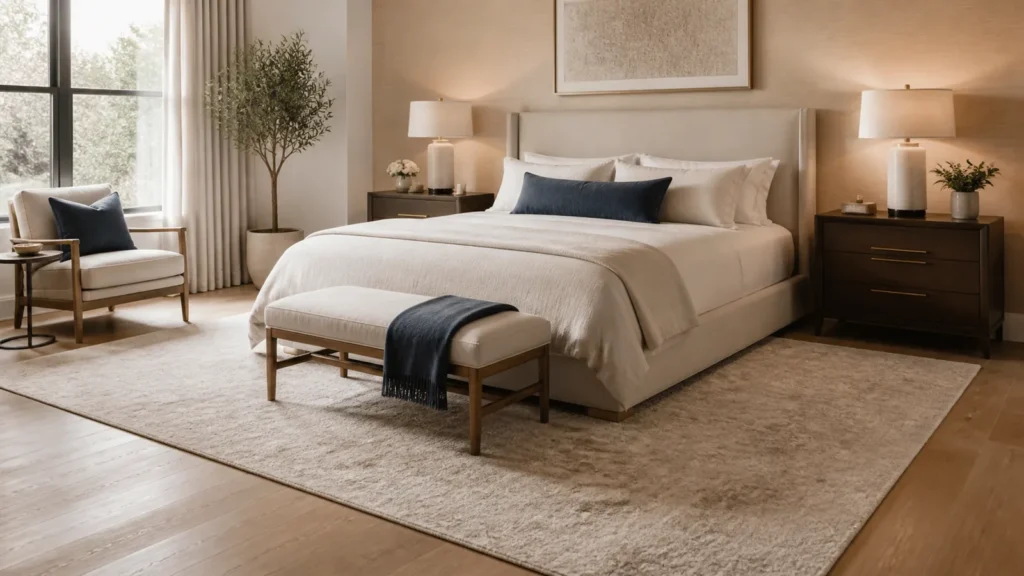
A bedroom rug should feel generous when you step out of bed, fit the room without crowding walls or doors, and support the furniture arrangement you actually have. The right answer depends on more than whether your mattress is a queen or king.
This guide combines standard U.S. mattress dimensions with practical placement choices, room clearances, nightstands and benches. Use the calculator for a starting point, then mark the proposed footprint with painter’s tape before ordering. The recommendations are planning guidance—not mandatory design rules.
Bedroom Rug Size Calculator
Enter the room and furniture plan. Results identify standard sizes worth taping on the floor; they do not guarantee fit for every bed frame or rug manufacturer.
Start With the Bed—Then Measure the Frame
Standard mattress dimensions create a consistent starting point. In the United States, the six common sizes run from a 38-by-75-inch twin to a 72-by-84-inch California king. The finished bed can be wider or longer because of an upholstered surround, platform rail, headboard or footboard. Measure the frame at its widest and longest points before making a final purchase.
| Bed | Typical mattress | Compact/partial starting point | More generous starting point |
|---|---|---|---|
| Twin | 38 × 75 in. | 5 × 7 or 5 × 8 | 6 × 9 |
| Twin XL | 38 × 80 in. | 5 × 8 | 6 × 9 |
| Full | 54 × 75 in. | 5 × 8 or 6 × 9 | 8 × 10 |
| Queen | 60 × 80 in. | 6 × 9 | 8 × 10 or 9 × 12 |
| King | 76 × 80 in. | 8 × 10 | 9 × 12 or 10 × 14 |
| California King | 72 × 84 in. | 8 × 10 | 9 × 12 or 10 × 14 |
These are starting points, not promises. A 9-by-12 rug can sit differently under a queen than under a king, and a thick, oversized frame may reduce the visible border by several inches.
Four Useful Bedroom Rug Placements
Educational diagrams are simplified and not drawn to a universal room scale.
Lower two-thirds
Turn the rug so its longer dimension runs across the bed. Start it ahead of the midpoint and let it extend beyond the foot. This arrangement concentrates the visible rug where feet land while leaving the nightstands on the hard floor. It is often the most efficient way to use a 5-by-8, 6-by-9 or 8-by-10 rug.
Entire bed, nightstands off
Move the rug closer to the headboard but stop before the nightstands. This gives the bed a fuller frame without requiring the largest size. Check that the front edge extends far enough beyond a footboard or bench to look intentional and avoid creating a narrow strip that is difficult to vacuum.
Bed and nightstands together
A large rug beneath the whole furniture group can create a calm, unified primary bedroom. It requires enough width for the nightstands and enough length for the bed, foot exposure and any bench. Measure the full furniture envelope rather than adding mattress dimensions in isolation.
Runners or separate bedside rugs
Runners can provide a soft landing without placing a heavy bed on a large rug. They also suit a bed near a wall or a room with doors that would catch a thicker central rug. Keep each runner accessible from the usual exit side of the bed and use a compatible pad or backing to reduce movement.
Bedroom Rug Size by Bed
Twin and Twin XL
A 5-by-7 or 5-by-8 rug can work beneath the lower part of one twin bed. A 6-by-9 offers more visible material at the sides and foot. Twin XL adds five inches of mattress length, so verify foot exposure rather than assuming every twin layout transfers unchanged. For two twin beds, measure the combined arrangement—including the aisle and nightstands—before considering one shared rug.
Full bed
A 5-by-8 is a compact lower-two-thirds option, while a 6-by-9 generally provides a more useful landing area. An 8-by-10 gives enough flexibility for fuller coverage or a wider bed frame. In a small room, the difference between those sizes may be determined by closet clearance rather than appearance.
Queen bed
A 6-by-9 is usually the compact starting point when only the lower part of the bed sits on the rug. An 8-by-10 is a versatile step up. A 9-by-12 creates a broader perimeter and is more likely to accommodate nightstands or a bench, assuming the room leaves a comfortable border around it.
King bed
An 8-by-10 can work under the lower portion of a king, but the visible border may feel modest beside a wide frame. A 9-by-12 is a common practical target, while a 10-by-14 creates a more expansive furniture zone. Check the actual frame width: a platform or upholstered rail can meaningfully reduce the exposed rug beyond each side.
California king
A California king is four inches narrower and four inches longer than a standard king. That extra length matters when planning foot exposure. An 8-by-10 may suit partial placement; 9-by-12 or 10-by-14 sizes offer more flexibility for full-bed arrangements. Orient the longer rug dimension across the bed unless the room or placement plan clearly calls for the opposite.
Clearance Matters as Much as Rug Size
A mathematically adequate rug can still be wrong for the room. Before buying, look at the entire walking route and every moving part.
- Walls: leave visible flooring where possible so the rug reads as an area rug rather than mis-sized wall-to-wall carpet. The exact border is a design choice, not a code requirement.
- Doors: open bedroom, closet and bathroom doors fully. Include the rug pad and pile height when checking bottom clearance.
- Closets and drawers: confirm that drawers, sliding panels and bifold doors remain usable.
- Walkways: avoid placing a rug edge exactly where people pivot or where one foot repeatedly lands on and one foot off the rug.
- Floor registers: do not cover supply or return openings.
- Bench: allow its legs to sit securely in the intended position rather than balancing at a rug edge.
Do You Need a Rug Pad?
A compatible rug pad can reduce movement, add cushioning and help separate the rug backing from the finished floor. The correct pad depends on the rug construction and flooring manufacturer. A pad should normally sit slightly inside the rug perimeter so it does not show or create a raised edge.
Check compatibility before using rubber, latex or adhesive-backed products on hardwood, luxury vinyl, laminate or recently finished floors. Follow both the flooring and rug manufacturers’ care instructions. For doors and low-clearance furniture, include the combined rug-and-pad thickness in the fit check.
Choose the Size Before the Material
Material changes comfort, cleaning and cost, but it should not rescue a poor footprint. Decide which part of the furniture group the rug needs to support, confirm the size with tape, and then compare materials available in that size. This order prevents a common shopping mistake: falling in love with a pattern that is available only in a dimension that crowds the room or barely reaches beyond the bed.
Wool
Wool can offer softness, resilience and a substantial feel, but construction and care requirements vary. A thick wool rug plus a dense pad can create more height at a door or bed leg than a flat sample suggests. Check shedding, cleaning instructions and the finished edge before purchase.
Synthetic fibers
Polypropylene, polyester and nylon rugs cover a wide range of pile heights and constructions. They may be useful where easy maintenance or budget matters, but fiber name alone does not establish durability or floor compatibility. Review the individual rug’s care guidance and backing.
Natural plant fibers
Jute, sisal and similar materials add visible texture and often have a lower-profile appearance. They may feel firmer under bare feet and can respond differently to moisture and spot cleaning. A bedroom rug does not need to be plush, but it should suit how the room is actually used.
Washable and low-pile rugs
Washable construction may be attractive for children, pets or allergy-conscious routines. Before choosing an oversized washable rug, confirm that the cleaning method is realistic for its weight and dimensions. Low pile can help with doors and mobility, while a high pile needs extra attention at walking edges.
How Rug Orientation Changes the Result
Most rectangular bedroom rugs are placed with their longer dimension running across the bed. For example, an 8-by-10 is typically arranged with the 10-foot dimension side-to-side and the 8-foot dimension running from the head toward the foot. That orientation produces more landing space on both sides.
Rotating the same rug 90 degrees trades side exposure for length. This can be useful in an unusually narrow room, beside a wall-side bed, or when the primary goal is covering the foot zone. It is not inherently wrong, but the calculator assumes the conventional long-side-across orientation when reporting side exposure.
Planning for Nightstands and a Bench
Nightstands on the rug
Measure from the outside edge of one nightstand to the outside edge of the other. Compare that total with the rug dimension running across the bed. If the rug is narrower than the group, partially supported nightstand legs can wobble. A larger rug is not automatically better if it then approaches walls, doors or floor registers.
Nightstands off the rug
Keep the rug’s head-side edge forward of the nightstand feet. Both nightstands should rest on the same floor level. This arrangement usually allows a smaller size and makes it easier to change the bedside furniture later.
Bench at the foot
A bench changes the required length, especially when you want all four legs on the rug. Measure the bench depth and the gap between bench and bed, then add the desired visible rug beyond the bench. If only two legs land on the rug, confirm that the difference in floor height does not make the bench unstable.
Common Bedroom Rug Sizing Mistakes
- Measuring only the mattress: a frame can add several inches on every side.
- Reading the dimensions backward: verify which rug edge will run across the bed.
- Ignoring the door sweep: a rug may fit the floor plan but stop a closet or ensuite door.
- Centering on the room instead of the bed: the two centers are not always the same, particularly with asymmetrical windows or doors.
- Choosing by photo alone: wide-angle photography can make a rug’s border appear larger than it is.
- Forgetting the pad: its thickness and dimensions affect doors, edges and furniture stability.
- Buying too soon: tape both the smaller and larger options before deciding.
How to Measure Before You Buy
- Measure the completed bed frame—not just the mattress.
- Measure the room side-to-side and head-to-foot.
- Record the nightstand group width and the bench footprint.
- Choose partial, full or runner placement before choosing a size.
- Mark the candidate rug dimensions with low-tack painter’s tape.
- Open every nearby door, drawer and closet panel.
- Walk the normal route around the bed.
- Compare the taped minimum and generous options for at least a day.
- Confirm the retailer’s actual dimensions; a nominal size may vary.
- Select a rug pad only after checking flooring compatibility.
Browse bedroom rugs after confirming the footprint
If you have measured the bed and room, taped the candidate footprint, and confirmed door and furniture clearances, BENI offers customizable rugs with selectable sizes and design options. Verify the current dimensions, lead time, care information, and return terms on BENI before ordering.
Browse customizable rugs at BENIHow This Differs From Living Room Rug Sizing
A bedroom rug is organized around the bed footprint and the landing area for your feet. A living room rug is organized around a seating group, circulation and furniture-leg placement. If you are planning another room, use Larmine’s Living Room Rug Size Guide & Calculator rather than applying the bedroom recommendations to a sofa arrangement.
Frequently Asked Questions
Is an 8-by-10 rug big enough for a queen bed?
Often, yes. It can provide generous lower-two-thirds coverage or fuller bed coverage with the nightstands off the rug. The actual result depends on the frame width, orientation, room border and desired side exposure.
What rug size works best under a king bed?
An 8-by-10 can work for partial placement. A 9-by-12 generally provides a more balanced border, while a 10-by-14 can include more of the furniture group in a larger room. Tape the footprint before ordering.
Should nightstands sit on the rug?
They can, but they do not have to. Including them creates a unified furniture group and usually requires a larger rug. Keeping them off the rug makes partial placement more economical and can simplify leveling.
How far should a rug extend beyond the bed?
Credible retailer guidance varies, commonly suggesting roughly 12 to 24 inches depending on bed and layout. Treat that range as a visual and practical planning reference, then adjust for the room and bed frame.
Can I use runners instead of one large rug?
Yes. Two bedside runners—or one on the accessible side—can add comfort in a narrow room and avoid placing the bed over a large rug. Secure them appropriately and keep edges away from door swings.
Does a rug have to be centered under the bed?
No. Centering often creates visual balance, but an intentionally offset placement may work when a bed sits near a wall or the room is asymmetrical. Prioritize usable landing space and safe circulation.
Sources and Method
Larmine did not physically test rugs for this guide. We compared current U.S. mattress dimensions and multiple retailer planning resources, then created original decision logic for bed placement and room-fit warnings.
- Sleep Foundation — Mattress Sizes 101
- IKEA U.S. — Mattress dimensions
- Pottery Barn — Bedroom Rug Buying Guide
- Crate & Barrel — Area Rug Buying Guide
- The Home Depot — Rug Sizes for Your Space
- Lowe’s — How to Choose the Best Area Rug
Plan the footprint before ordering
Use painter’s tape to compare both calculator results in your actual room. The best size is the one that supports the bed, clears the room and feels comfortable in daily use.
Return to the calculator