
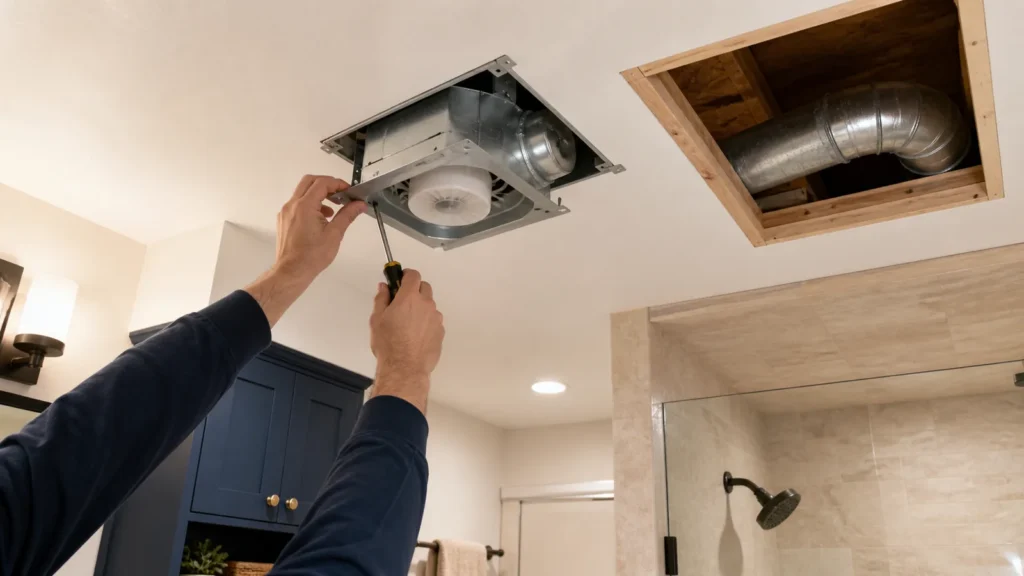
Bathroom fan installation cost depends less on the grille you see and more on what is hidden above the ceiling. A like-for-like replacement with compatible wiring and ductwork is a different project from adding a new fan, cutting a roof or wall termination, running a new circuit, or repairing finished surfaces.
Quick answer: current U.S. cost publishers show overlapping—but not interchangeable—examples. Thumbtack lists roughly $183–$444 as a national installation range, HomeAdvisor lists about $146–$386 for replacement, and Homewyse models approximately $343–$889 for a basic installation under readily serviceable conditions. Angi publishes a broader $120–$900 project range and identifies $200–$800 as a labor range when electrical work, ductwork, venting, or roofing may be involved. These pages use different scopes, dates, locations, and methodologies, so treat them as planning references—not as a quote for your bathroom.
Editorial note: Larmine reviewed current published cost references and installation-planning information. We do not provide contractor quotes, and we did not perform or price a physical installation. Local labor, access, permits, materials, and project conditions can change the total substantially.
Practical review: Paulo Padilha reviewed the project-scope discussion for practical clarity, including access, duct routing, electrical coordination, exterior termination, and finish repair. This review does not replace the cited cost sources or local professional quotes.
Current published bathroom fan cost examples
| Source | Published example | What the source includes or assumes | Important limitation |
|---|---|---|---|
| Thumbtack, updated June 5, 2026 | About $183–$444 | Installation range spanning basic replacement through more involved work; the page identifies fan type, new ductwork, electrical work, access, and local labor as variables | It is a national marketplace range, not a location-specific quote |
| HomeAdvisor, updated June 17, 2026 | About $146–$386 | Bathroom-fan replacement; its page separately discusses equipment, labor, and potential duct replacement | A compatible replacement is narrower than a completely new installation |
| Homewyse, May 2026 | About $343–$889 | A modeled basic installation with a 70-CFM fan, basic labor, mounting hardware, connection to electrical and venting, and favorable service conditions | The example excludes permits and work needed to repair or modify existing systems and finishes |
| Angi, updated August 1, 2026 | About $120–$900 total; $200–$800 labor | Broad project range; labor can reflect electrical work, ductwork, venting, and roofing | The labor figure is not the complete project price and should not be combined blindly with another source’s total |
The responsible way to use these numbers is to identify which scope resembles your project, then request itemized local quotes. Do not average the four ranges: replacement and new-installation figures are answering different questions.
The three project types that change the budget
1. Like-for-like fan replacement
This is the narrowest scope: an existing fan already has power, a usable exterior duct route, and an opening that can accept the replacement housing or a supported retrofit method. Labor can still increase if the old housing is difficult to remove, the duct is undersized or damaged, wiring needs correction, or the ceiling requires patching.
2. Replacement with duct or electrical correction
A new quiet fan may specify a larger duct than the old unit. A crushed flexible run, disconnected exterior cap, unsafe wiring, or missing switch function can turn a simple replacement into a multi-trade project. Review the bathroom fan ducting guide before comparing quotes so the route, diameter, insulation, and termination are included.
3. Completely new fan installation
A new installation may require a ceiling opening, housing support, wiring and switching, a duct route, an exterior wall or roof cap, air sealing, insulation work, permits or inspections, and finish repair. Access above the bathroom—open attic, finished floor, flat roof, or inaccessible cavity—can be more important to labor than the fan price.
What should be included in an itemized quote?
- Exact fan model and airflow setting
- Removal and disposal of the existing unit, if applicable
- Housing modification, framing, and ceiling repair
- Electrical circuit, switch, timer, sensor, and wiring work
- Duct material, diameter, length, elbows, insulation, and supports
- Exterior wall or roof termination and damper
- Air sealing around the housing and penetrations
- Permit and inspection fees when required locally
- Painting or other finish work
- Warranty on labor and responsibility for callbacks
A low bid that excludes the exterior termination or duct correction may not be comparable to a quote that includes the complete ventilation path.
Cost factors homeowners can check before calling
Airflow and fan type
Calculate the airflow range first with the Bathroom Fan CFM Calculator. Selectable airflow, humidity sensing, lighting, heaters, and continuous-ventilation controls can affect both equipment and wiring scope. Buying an undersized fan because it is inexpensive usually does not reduce moisture effectively.
Sound expectations
Quiet models are often chosen during replacement, but compare sones at the airflow and test condition you intend to use. The guide to bathroom fan sones explains why a restrictive duct can make the installed result different from a laboratory label.
Access and finish conditions
An open attic can make housing and duct access simpler. A finished room above, tiled ceiling, plaster, limited joist space, or roof access may require additional protection and repair. Send contractors clear photos of the grille, switch, attic or ceiling access, exterior termination, and electrical panel when requesting an initial conversation.
Illustrative project scenarios
These scenarios organize scope; they are not Larmine estimates or contractor quotes.
| Scenario | Likely included work | Questions that change the price |
|---|---|---|
| Simple replacement | Remove the existing unit, install a compatible fan, reconnect existing wiring and usable duct, test, and clean up | Does the new housing fit? Is the existing duct the required size and in good condition? |
| Replacement plus correction | Replace the fan and correct a damaged or restrictive duct, controls, wiring, ceiling opening, or exterior cap | How much of the route is accessible? Is finish repair included? Does another trade need to be coordinated? |
| Completely new installation | Create the opening, support the housing, add wiring and controls, run duct to an approved exterior termination, seal and insulate, then repair finishes | Is there attic access? Wall or roof termination? Permit or inspection? Who handles electrical, roofing, and patching? |
DIY versus professional installation
A grille or motor assembly that the manufacturer specifically designs for room-side replacement may be manageable for an experienced homeowner when the power is safely isolated and no wiring, duct, housing, or exterior penetration changes are needed. That is not the same task as installing a new fan system.
New or altered wiring, an unfamiliar circuit, a roof penetration, concealed damage, difficult attic access, or a new exterior duct route are strong reasons to use qualified local professionals. Do not work on energized wiring or improvise a termination into an attic or other enclosed space. Confirm permits, trade licensing, and inspection requirements with the local authority having jurisdiction.
How to compare quotes without choosing only by price
- Give each contractor the same project description and exact fan model or performance requirements.
- Ask whether the quote assumes replacement or includes new duct, wiring, termination, and finish repair.
- Confirm who is responsible for permits and inspections required by the local authority.
- Ask what will happen if the existing duct or wiring is found to be unsuitable after work begins.
- Compare labor warranty, scheduling, cleanup, and documentation—not only the total.
- Verify licensing and insurance requirements through the appropriate state or local source rather than relying only on a marketplace badge.
When a higher quote may be reasonable
A higher quote can reflect a complete exterior duct route, safer electrical correction, difficult access, a roof penetration, proper insulation and air sealing, permit coordination, or finish repair. It is not automatically better; the important point is whether the scope is explicit and necessary.
Once the installation scope is clear, compare current model categories in Best Quiet Bathroom Exhaust Fans for Different Bathrooms. Keep the product decision separate from the labor quote so substitutions are easy to identify.
When replacement makes sense
Replacement deserves consideration when the existing fan cannot provide the required airflow, has an objectionable sound level, no longer operates reliably, lacks useful moisture controls, or cannot connect appropriately to a corrected duct system. Persistent humidity is not proof that the motor alone is the problem: an undersized fan, blocked or disconnected duct, failed damper, poor exterior termination, or insufficient run time can produce similar symptoms.
Diagnose the full airflow path before paying for a premium fan. A quieter, higher-priced unit cannot compensate for a crushed duct or a termination that does not open.
Frequently asked questions
Is replacing a bathroom fan cheaper than installing a new one?
Usually, when the existing wiring, duct route, exterior cap, ceiling opening, and controls are compatible. If any of those elements require correction, the replacement can approach the scope of a new installation.
Does the fan price include installation?
Not unless the retailer or contractor explicitly bundles installation. Confirm whether the quoted amount includes the fan, labor, materials, disposal, tax, permit fees, and finish work.
Do I need an electrician, HVAC contractor, roofer, or general contractor?
The answer depends on the wiring, ducting, exterior penetration, project scope, and local licensing rules. A simple replacement may be handled differently from a new circuit and roof termination. Ask the local permitting authority which trade and permit requirements apply.
Can I use an online cost range as a budget?
Use it only as an early reference. Online ranges combine different locations and scopes. A written local quote based on the actual ceiling, electrical system, duct route, exterior termination, and finish conditions is more useful.
Final planning checklist
- Calculate target airflow.
- Choose required controls, lighting, and sound range.
- Photograph the existing fan, switch, access area, duct, and exterior cap.
- Decide whether the request is replacement, correction, or new installation.
- Request the same itemized scope from more than one qualified local provider.
- Verify permit, licensing, and inspection requirements locally.
- Keep a written record of model number, airflow setting, duct route, and warranty.
For more homeowner planning resources, visit the Larmine Bathroom hub.