
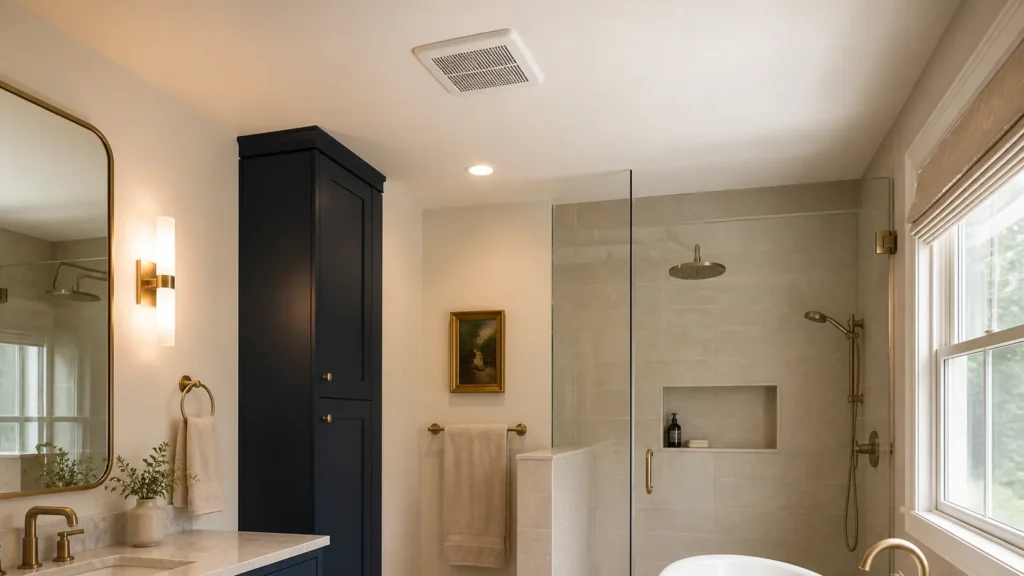
A quiet bathroom fan should move the airflow your room needs without making every shower sound like a workshop. The best choice depends on more than the lowest sone number: bathroom size, duct resistance, controls, lighting, and replacement constraints all matter.
Editorial note: Larmine compared current manufacturer documentation, ENERGY STAR information where available, installation requirements, airflow settings, and sound ratings. We did not physically test these fans. Product specifications and U.S. availability were checked before publication but can change.
Quick comparison
| Model | Airflow | Published sound rating | Best for | Key feature |
|---|---|---|---|---|
| Panasonic FV-0511VF1 | 50/80/110 CFM | Varies by setting and static pressure | Most bathrooms and retrofit projects | Selectable airflow |
| Panasonic FV-0511VQC1 | 50/80/110 CFM | <0.3 sones at 0.1 in. w.g.; higher at 0.25 depending on setting | Automatic moisture control | Humidity and motion sensors |
| Broan-NuTone AE50 | 50 CFM | 0.5 sones | Small bathrooms or powder rooms | Simple room-side installation |
| Broan-NuTone AE80K | 80 CFM | 0.7 sones | Straightforward 80-CFM replacement | CleanCover grille |
| Broan-NuTone AER110CCTK | 110 CFM | 1.0 sone | Bathrooms needing a fan and ceiling light | Selectable-CCT LED |
| Delta Breez SLM50-110-C | 50/80/110 CFM | <0.3/0.4/1.2 sones at 0.1 in. w.g. | Shallow wall or ceiling space | Low-profile housing |
| Delta Breez SIG80-110D | 80/110 CFM plus low-speed settings | Setting- and pressure-specific | Continuous or dual-speed ventilation | Low-speed and delay controls |
Start with airflow, not the product list. Use the Bathroom Fan CFM Calculator to estimate a useful airflow range. Then compare sound using our guide to bathroom fan sones. A very quiet undersized fan is still the wrong fan.
How we chose these quiet bathroom fans
We prioritized models with current U.S. manufacturer pages, clear model numbers, documented airflow and sound data, and installation information a homeowner can verify before buying. ENERGY STAR certification was considered when applicable, but certification alone does not determine whether a fan fits a particular bathroom or duct system.
- Airflow fit: fixed or selectable CFM that can match common bathroom needs.
- Sound context: published sones without presenting different test conditions as identical.
- Duct compatibility: duct connection and housing constraints that can affect a replacement.
- Useful controls: humidity sensing, continuous low speed, delay, lighting, or straightforward manual operation.
- Current support: a live manufacturer page or current manufacturer documentation. Discontinued models were excluded.
Best overall adjustable quiet fan: Panasonic WhisperFit DC FV-0511VF1
The FV-0511VF1 is the most flexible starting point for many replacement and renovation projects because its Pick-A-Flow selector provides 50, 80, or 110 CFM in one housing. That lets the installer choose an airflow setting after confirming the bathroom’s needs instead of committing to a single rating at purchase.
Panasonic specifically positions this model for renovation and room-side work. Its documentation also publishes sound performance under more than one static-pressure condition—an important advantage when comparing quiet claims realistically. A restrictive duct can still reduce performance or change the installed sound, so check the complete bathroom fan ducting path before treating any laboratory rating as a guarantee.
- Why it stands out: three airflow settings and retrofit-oriented design.
- Check before choosing: housing depth, mounting access, duct connection, and the selected CFM.
- Best fit: homeowners who want one current model that can cover several common bathroom sizes.
Best with automatic moisture control: Panasonic WhisperSense DC FV-0511VQC1
WhisperSense adds built-in humidity and motion sensing to the same useful 50/80/110-CFM concept. Panasonic lists an adjustable humidity setting from 30% to 80% relative humidity, making it appropriate when people frequently forget to turn a fan on or leave it running long enough.
The sound specification illustrates why context matters. Panasonic lists less than 0.3 sones at 0.1 inch water gauge for the selectable airflow settings, while the documented values at 0.25 inch are higher and vary by setting. ENERGY STAR’s current listing also identifies the model as certified and Most Efficient. Those are useful comparison points, not a promise that every installation will sound the same.
- Why it stands out: airflow selection plus automatic humidity and occupancy response.
- Check before choosing: sensor behavior, wall-switch plan, duct configuration, and whether a light is required; this model does not include one.
- Best fit: shared bathrooms and households where automatic operation is more reliable than reminders.
Best simple option for a small bathroom: Broan-NuTone AE50
The AE50 is a focused 50-CFM fan rather than a feature-heavy system. Broan-NuTone rates it at 0.5 sones, specifies a 4-inch duct, and describes room-side installation without attic access. The manufacturer lists it for rooms up to 45 square feet, but use the actual sizing calculation and local requirements instead of relying on a room-size label alone.
- Why it stands out: quiet fixed airflow, current manufacturer support, and uncomplicated controls.
- Check before choosing: whether 50 CFM is sufficient and whether the existing opening and 4-inch duct are compatible.
- Best fit: a small bathroom or powder-room replacement that does not need a sensor or light.
Best straightforward 80-CFM replacement: Broan-NuTone AE80K
The AE80K provides a current, fixed 80-CFM option rated at 0.7 sones. Its room-side installation approach and low-slot CleanCover grille can be attractive for a conventional replacement where selectable speeds and automatic sensing would add complexity without adding value.
- Why it stands out: familiar fixed airflow and a clean ceiling appearance.
- Check before choosing: exact housing dimensions, duct connection, ceiling access, and whether 80 CFM matches the calculation.
- Best fit: a medium-size bathroom needing a basic quiet fan.
Best quiet fan with a light: Broan-NuTone AER110CCTK
The AER110CCTK combines 110 CFM with a 1.0-sone published rating and an LED light whose color temperature can be selected. It is a practical choice when the ceiling opening needs to provide both ventilation and general light, especially where adding another fixture would complicate the project.
- Why it stands out: current 110-CFM fan/light configuration with adjustable light color.
- Check before choosing: housing and wiring requirements, light output, duct connection, and whether one ceiling light is enough for the room.
- Best fit: a medium or larger bathroom where combined ventilation and lighting simplify the ceiling plan.
Best for shallow wall or ceiling space: Delta BreezSlim SLM50-110-C
The SLM50-110-C is designed around a slim housing and supports ceiling or wall mounting. Delta lists selectable 50, 80, and 110 CFM settings with published sound ratings of less than 0.3, 0.4, and 1.2 sones respectively at 0.1 inch water gauge. That change across settings is a useful reminder that “this fan is 0.3 sones” would be an incomplete description.
- Why it stands out: installation flexibility where framing depth is limited.
- Check before choosing: the 4-inch oval duct connection, allowed orientation, wall/ceiling details, and the sound rating at the intended airflow.
- Best fit: shallow framing or a wall-mount condition supported by the installation manual.
Best for dual-speed or continuous ventilation: Delta BreezSignature SIG80-110D
The current SIG80-110D replaces the discontinued SIG110D and supports 80- or 110-CFM full-speed operation plus adjustable continuous low-speed settings and delay control. It suits a ventilation plan that calls for low background airflow with a higher boost when needed, rather than simple on/off operation.
Delta’s submittal data separates airflow and sound by speed and static pressure. That makes it a better source than retailer summaries that collapse the model into one quietness number.
- Why it stands out: continuous low-speed options and a timed transition to full speed.
- Check before choosing: control wiring, local continuous-ventilation requirements, duct design, and commissioning settings.
- Best fit: projects designed for continuous ventilation or more deliberate moisture-control operation.
What “quiet” really means when the fan is installed
A sone rating is useful only when you compare the airflow and test condition attached to it. Some adjustable fans become more audible at their highest setting. Published values can also differ between 0.1 and 0.25 inch water gauge because the fan is working against more resistance.
- Use the shortest practical smooth duct route permitted by the manufacturer and project design.
- Match the required duct diameter; reducing it can add resistance and noise.
- Limit unnecessary elbows and crushed flexible duct.
- Use a compatible exterior termination with a working damper.
- Mount the housing and grille securely to avoid vibration or rattling.
- Confirm the selectable CFM and control settings after installation.
How to choose the right model
1. Calculate the airflow range
Start with bathroom area and fixtures. Larger bathrooms and enclosed toilet rooms may require a different approach from a compact bath. The Larmine calculator explains the sizing references and limitations.
2. Compare sones at the setting you will use
Do not compare one model at 50 CFM with another at 110 CFM and assume the lower number represents better engineering. Check the manufacturer’s table and static-pressure column when it is published.
3. Inspect the existing installation
Measure the opening, housing depth, joist orientation, ceiling access, duct diameter, outlet direction, wiring, and exterior route. “Room-side installation” can reduce attic work, but it does not guarantee that every existing opening or duct will fit.
4. Choose controls intentionally
A humidity sensor is useful when manual operation is unreliable. A timer may be simpler when occupants already turn the fan on. Continuous low speed belongs in a ventilation design, not as a feature selected without understanding how it will be commissioned.
5. Verify the exact model before buying
Bathroom fan families often contain nearly identical model numbers for fan-only, light, sensor, finish-pack, or regional versions. Match the model number on the manufacturer page, installation manual, retailer listing, and box before purchase.
Frequently asked questions
How many sones is considered quiet for a bathroom fan?
Many homeowners consider a fan around 1.0 sone or lower quiet, while models below 0.3 sones can be difficult to hear in ideal conditions. The useful comparison is the rating at the airflow and static pressure relevant to your installation.
Is a nearly silent bathroom fan working?
Low sound alone does not indicate failure. Check the grille for airflow using the manufacturer’s recommended method and confirm the selected speed, duct connection, damper, and exterior termination. Do not use unsafe improvised tests near moving or electrical parts.
Does higher CFM always make a bathroom fan louder?
Not always, because motor, blower, housing, grille, duct and test conditions differ. Within the same adjustable model, however, the highest airflow setting may have a higher published or installed sound level.
Should I choose a humidity sensor or a timer?
Choose based on household behavior and control requirements. A sensor can respond automatically to moisture; a timer offers predictable manual operation. Some installations combine control functions, but wiring and manufacturer instructions must support the plan.
Can I connect a quiet new fan to an old 3-inch duct?
Only if the exact fan and an approved transition support it. Many current quiet fans specify 4- or 6-inch connections. Reducing duct size can increase resistance, reduce delivered airflow, and make the system more audible.
Final recommendation
The Panasonic FV-0511VF1 is the most adaptable starting point for many bathrooms because it combines three airflow settings with a renovation-oriented installation design. Choose the FV-0511VQC1 when automatic humidity and motion response add real value. For a simpler fixed-airflow replacement, the Broan-NuTone AE50 and AE80K are easier to evaluate, while the AER110CCTK adds integrated lighting. Delta’s SLM50-110-C addresses shallow installations, and the SIG80-110D serves projects that need dual-speed or continuous ventilation.
Before buying, confirm airflow with the calculator, compare the exact sound test condition, and inspect the entire duct route. The quietest specification cannot compensate for the wrong CFM, a restrictive duct, or an incompatible housing.
For more planning help, explore Larmine’s Bathroom guides.
Before scheduling the work, use our bathroom fan installation cost guide to separate a simple replacement from new ducting, electrical, termination, and finish-repair scope.